
Based on the Pool Re’s experience in selecting a new GRC platform, here are three key factors to focus on when evaluating potential solutions.
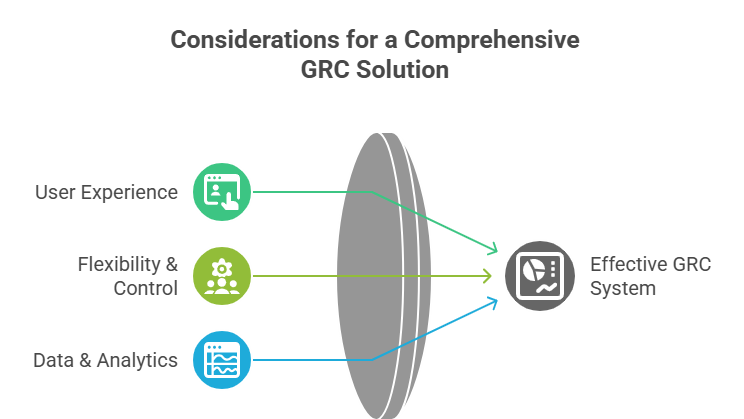
1. Prioritize user experience
A great GRC system should be intuitive and easy to use, especially for business users who aren’t working in it every day.
“If you need to engage the business to get stuff done in the system, then it has to be simple to use because they won’t be working on the tool on a daily basis like we are. So it has to be quite intuitive, very easy to use.”
2. Look for flexibility & control
A tool should allow teams to make necessary adjustments themselves without always relying on vendor support.
“We found that we ended up wasting a lot of time, and a lot of things didn’t get done because we couldn’t make the edits ourselves. We didn’t have the time to raise a ticket, explain and then wait for the configuration from the vendor. So having that flexibility to be able to do a lot of the things yourself, I think, is crucial.”

3. Ensure strong data & analytics capabilities
Quickly accessing and analyzing data is essential for modern risk management.
“We’re putting a lot of data in on a daily basis. There’s a lot going on. I want to be able to get a dashboard with the click of a button—see my risk environment, pull it into Excel or PowerPoint, and build MI reports very quickly.”
Bonus tip: don’t let price be the deciding factor
While cost is important, focusing too much on price differences can lead to choosing an inadequate tool.
“You may be saving a few thousand pounds, but then the work you have to do at the end to get the tool to do what you need undermines that savings. Sometimes, it’s better to just make the investment and get what you need.”
By keeping these key considerations in mind, organizations can ensure they choose a GRC tool that truly meets their needs.

About CoreStream GRC
CoreStream GRC is a flexible, intuitive governance, risk, and compliance platform designed to simplify and enhance how organizations manage risk. Our no-code solution empowers organizations to create tailored GRC systems that align with their business processes, delivered efficiently and without unnecessary complexity.
Built to scale with your business, the CoreStream platform provides the tools to identify, assess, evaluate, monitor, and report on risk, all within a single, streamlined interface. Whether you’re addressing IT risk, third-party risk, or compliance, CoreStream enables organizations to gain oversight and make informed decisions with confidence.
Trusted by leading enterprises such as the BBC, Deloitte, NHS, PwC Middle East, and Shell Energy, CoreStream GRC transforms risk management into a strategic advantage.
Strategic Risk Management at Scale
From a single risk module to a comprehensive GRC suite, CoreStream GRC supports organizations at every stage of their risk maturity journey.
Watch the full video
FAQ
The most successful organizations focus on three core factors when evaluating governance, risk, and compliance (GRC) platforms: user experience, flexibility, and data capability. A GRC tool should be intuitive enough for occasional users, flexible enough to allow configuration without vendor dependency, and powerful enough to deliver real-time insights that support strategic decision-making.
A great GRC tool must be simple to use, even for business users who only log in occasionally. Pool Re’s experience with CoreStream GRC highlighted that engagement depends on usability; if the interface is too complex, employees won’t interact with it effectively. The easier the platform is to navigate, the more value it delivers across the organization.
Modern risk management depends on instant access to accurate, actionable data. A strong GRC system enables users to analyze information, generate dashboards, and export reports effortlessly. This allows leadership teams to understand the organization’s risk environment at a glance and make informed decisions backed by data rather than assumptions.