
A cultural guide to GRC
Want to explore how stronger GRC culture can support better decisions, accountability, and more confident growth?
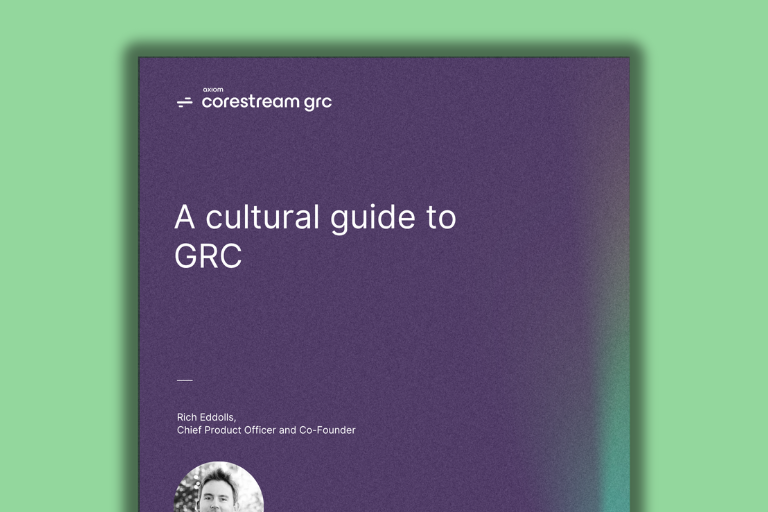
This guide was written by Rich Eddolls, Chief Product Officer and Co-Founder at CoreStream GRC
About Rich Eddolls
Richard Eddolls is Chief Product Officer and Co-Founder of CoreStream GRC, and the driving force behind the platform’s product vision. With 20 years’ experience in business-led GRC system design and a background at Deloitte, he focuses on solving real governance and risk problems, not selling theory.
His core belief is simple: technology should enable teams, not get in their way. That principle shapes every product decision, with flexibility and intuition built in from the start. Richard is focused on redefining how enterprises approach governance, risk, and compliance, on their own terms.
That view aligns with a broader shift in how the field is being framed. OCEG defines it as;
“GRC is the integrated collection of capabilities that enable an organization to achieve Principled Performance – the ability to reliably achieve objectives, address uncertainty, and act with integrity.”
Here is a preview of the guide:
Introduction: shaping a GRC culture that lasts
“Is GRC a culture, a practice or a program?”
Rich Eddolls, Chief Product Officer and Co-Founder at CoreStream GRC
Governance, Risk, and Compliance (GRC) can be many things depending on your organization’s maturity. Some see it as a software category. Others argue over terminology. But the most successful organizations treat GRC as a cultural foundation for how decisions are made and risks are managed.
That is increasingly how risk leaders describe it too. As Marlene Debel, Chief Risk Officer and Head of MetLife Insurance Investment, put it;
“The goal is to build a way of working in terms of capabilities and business partnership that drives responsible growth and will benefit the company for years to come.”
Change programs help implement or revise GRC practice. When done effectively, they move GRC from a tick-box exercise to a habit, deeply embedded in how teams work. There’s no one-size-fits-all approach, but practical steps toward a GRC-aware culture can make all the difference.
Or, as CoreStream GRC’s value-based GRC guide puts it, GRC should not be seen only as a defensive function, but as “a positive force to help organizations drive growth, achieve their goals and sustain their business into the future.”
Want to hear more about unlocking greater value from Governance, Risk, and Compliance programs?
Educate: build awareness, build ownership
“Making an organization risk-conscious is imperative.”
Rich Eddolls, Chief Product Officer and Co-Founder at CoreStream GRC
If employees see GRC as a burden, adoption will always be shallow. But when they understand the value, they’re more likely to own the process, not just follow it. GRC becomes accessible when people see it for what it is: formalized decision-making, informed by better data.
Education is essential. Teams should know how GRC affects performance, what risks they influence, and why poor practices matter. With the right awareness, GRC stops being theoretical and starts delivering real value.
Despite the best intentions, recent research shows that only about 53% of organizations report their risk and compliance programs are mature, showing there is still a long way to go before GRC becomes a business-wide habit rather than a siloed function.
Lead and reward: make GRC everyone’s business
“The desired GRC culture is frequently one that is inclusive and collaborative.”
Rich Eddolls, Chief Product Officer and Co-Founder at CoreStream GRC
Compliance that’s enforced top-down without involvement risks alienating the very people it needs. GRC works best when leaders set the tone and everyone shares ownership.
Incentivizing GRC through performance metrics, recognition, and leadership alignment embeds it into daily behavior. When GRC goals are linked to company success, they become more than policy; they become part of how success is defined.
Help, don’t hinder: GRC that supports, not slows
“GRC culture should encourage proactive prevention.”
Rich Eddolls, Chief Product Officer and Co-Founder at CoreStream GRC
Controls that feel like roadblocks erode engagement and slow the business. GRC should be proportionate, relevant, and focused on minimizing both the likelihood and impact of risk before issues arise.
For context, the average cost of a data breach in 2024 reached about $4.88 million globally, a 10% increase from the year before. That kind of financial hit, on top of operational disruption and reputational damage, shows why proactive risk management matters.
Done right, GRC doesn’t just protect, it empowers. It improves contract outcomes, strengthens ethical reputations, and enhances decision-making. It’s not just about avoiding failure; it’s about building advantage.
That wider upside is important. In PwC’s Global Compliance Survey 2025, respondents said the benefits of stronger compliance capabilities included better visibility of risks and risk management activities, faster identification and response to compliance issues, higher-quality reporting, and faster, more confident decision-making
“GRC is not only about avoiding the downside. It should actively drive value.”
Paul Cadwallader, GRC Strategy Director, CoreStream GRC
Standardize: simplify GRC across the organization
“Standardization will almost always drive significant benefits.”
Rich Eddolls, Chief Product Officer and Co-Founder at CoreStream GRC
When GRC processes evolve in silos, you end up with duplicated effort, inconsistent terminology, and audit fatigue. Standardization improves efficiency, clarity, and confidence at all levels.
Whether or not centralization is the goal, a consistent GRC framework with common language and reporting enables better decision-making. It also makes GRC more accessible from the shop floor to the boardroom.
Get the best from technology: use tools to enable, not replace
“Technology should be regarded as an enabler that improves the efficiency of people and processes; not as a substitute for them.”
Rich Eddolls, Chief Product Officer and Co-Founder at CoreStream GRC
GRC platforms should enhance your team’s work, not automate them out of it. Used well, technology consolidates information, streamlines repetitive tasks, and makes GRC more intuitive.
But sophistication can create diminishing returns. Often, 80% of the benefit comes from 20% of the effort. Focus on usability, clarity, and efficiency, and avoid creating complexity in the name of automation.
That point matters because poor-fit technology carries its own costs. As per our research 50% of businesses are unsatisfied with their current GRC tools, while one cited risk of the wrong setup is added cost from overlap and unnecessary complexity.
Keep it simple: simplicity drives adoption
“Keeping things simple is overarching and something to be conscious of at all times.”
Rich Eddolls, Chief Product Officer and Co-Founder at CoreStream GRC
Complicated GRC frameworks alienate users and stall adoption. Simplicity of language, process, and controls makes GRC scalable and sustainable. Even complex regulation can be translated into logical, accessible controls.
The most effective GRC cultures are built on clarity. By addressing complexity at the design stage, organizations make it easier for people to engage and own the process.
Want to continue reading?
Download the full guide to explore how you can build a GRC-aware culture that drives engagement, accountability, and long-term value.
Continue your GRC learning, speak to our team of experts

-

CASE STUDY: Implementation success story
Raising the bar on Conflict of Interest management: CoreStream GRC’s high quality implementation services success story Everyone’s heard the horror stories of GRC implementations that drag on for months, sometimes years, with personnel moving in and out as people leave before the project is done. It’s no wonder risk and compliance teams cling to the devil they know. The fear of scope creep, decision paralysis, slipping timelines, and sheer…
-

CASE STUDY: Wood Group
Simplifying global audit management with CoreStream GRC Key takeaways Wood is a global engineering and operations business with around 35,000 people across 60 countries. After a major acquisition, its assurance, action tracking and non-conformance processes were spread across around 45 different systems: “We found we had somewhere in the region of 45 action tracking systems. They ranged from HTML to SharePoint…
-
CASE STUDY: COI GRC 2020 solution perspective
The client stories behind Michael Rasmussen’s Conflict of Interest Management solution perspective for CoreStream GRC Introduction Michael Rasmussen, globally recognized GRC thought leader and former Forrester analyst who originally defined the Governance, Risk, and Compliance market, recently drafted his perspective on CoreStream GRC’s conflict of interest solution. For this analysis, Michael engaged with 3 organizations actively using the CoreStream GRC platform to manage conflicts of interest. While operating in…
FAQ
Building a GRC culture means treating governance, risk, and compliance not as a checkbox activity but as a shared mindset embedded across the organization. CoreStream GRC emphasizes that a strong GRC culture helps teams make informed decisions, manage risks proactively, and align ethical behavior with business success. It turns compliance from a reactive function into a natural part of how work gets done.
Education is at the heart of lasting GRC adoption. CoreStream GRC advises that when employees understand how governance and risk management directly impact performance and decision-making, they’re more likely to take ownership of the process. Training and awareness transform GRC from a burden into a meaningful, empowering framework that supports better business outcomes.
Building a GRC culture means treating governance, risk, and compliance not as a checkbox activity but as a shared mindset embedded across the organization. CoreStream GRC emphasizes that a strong GRC culture helps teams make informed decisions, manage risks proactively, and align ethical behavior with business success. It turns compliance from a reactive function into a natural part of how work gets done.
Education is at the heart of lasting GRC adoption. CoreStream GRC advises that when employees understand how governance and risk management directly impact performance and decision-making, they’re more likely to take ownership of the process. Training and awareness transform GRC from a burden into a meaningful, empowering framework that supports better business outcomes.
Technology should enable people, not replace them. CoreStream GRC’s platform is designed to simplify governance processes, automate repetitive tasks, and make risk and compliance management more intuitive. By consolidating data and workflows in one place, CoreStream GRC allows organizations to focus on decision-making and value creation rather than administrative complexity.