Game-changing third party risk management is here
Powered by CoreStream GRC + SANNOS + Xapien
Legacy third party risk management approaches are failing
As regulatory expectations increase under DORA, NIS2, GDPR, AI Act and sector-specific regulations, TPRM teams face an impossible challenge:
- More suppliers to assess
- More evidence to review
- More regulatory obligations
- More scrutiny from auditors and regulators
- No corresponding increase in resources
Most organizations start with screening vendors for sanctions, PEPs, watchlists, and adverse media to generate initial alerts and identify red flags. They then assess the vendors via questionnaires, self-attestations, and evidence reviews.
However, these assessments are typically static and point-in-time, resulting in slow processes, inconsistent decisions, limited coverage, and rising compliance risk. Even together, alerts and assessments only provide a partial static view. TPRM teams need continuous, connected insight into both external signals and control effectiveness.

It’s time to revolutionize your vendor risk program
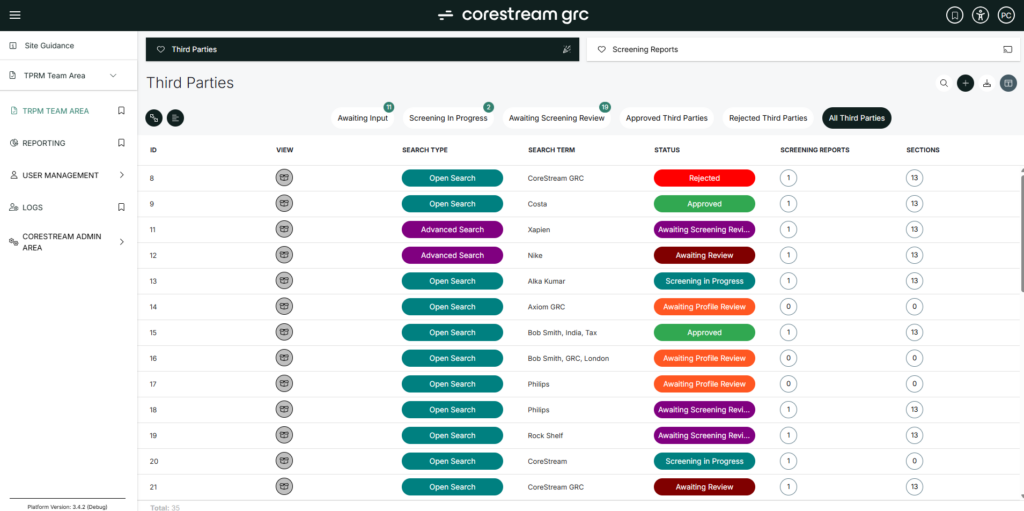
CoreStream GRC, Xapien and SANNOS transform third-party assessments from a manual, static, questionnaire exercise into an evidence-driven risk evaluation process.
Xapien Due Diligence Layer provides:
- External intelligence on the supplier, related people and organizations:
- Automated due diligence reports on people and organizations
- Corporate registry, sanctions, PEP, watchlist and global media research
- Adverse media, legal proceedings, financial crime, ABAC, ESG and reputational risk visibility
- Beneficial ownership, business associates, related organizations and location intelligence
- Fully sourced findings, with each claim linked back to the underlying source
- Ongoing monitoring to help keep due diligence current after onboarding
CoreStream GRC enables:
- Vendor inventory and lifecycle management
- Risk classification and workflows
- Assessment orchestration
- Issue and remediation management
- Continuous monitoring
SANNOS Intelligence Layer automates:
- Audit-ready documentation
- Evidence review
- Contract analysis
- Control assessment
- Regulatory mapping
- Gap identification

Together, CoreStream GRC orchestrates the TPRM workflow, SANNOS assesses vendor evidence and controls, and Xapien adds the outside-in due diligence view.
This gives teams a clearer, faster and more defensible understanding of both what a vendor says about its controls and what external intelligence shows about its risk profile.
“The questionnaire is not dead. But the blanket questionnaire is. The future is targeted, evidence-first, and proportionate to risk.”

GRC Strategy Director, CoreStream GRC
Improve the quality of your TPRM program whilst reducing time taken
The numbers speak for themselves.
100+
pages of vendor evidence reviewed in 1-2 minutes
95%
acceleration in TPRM assessments
30-70%
shortened third-party onboarding cycle

Assess your suppliers once – comply across many frameworks
We evaluate provided policies, certifications, reports, contracts, plans and documents.
So, a single assessment provides visibility across multiple regulatory obligations simultaneously, as they are automatically evaluated against
- DORA
- NIS2
- ISO 27001
- SOC 2
- CMMC
- NIST
- AI Governance
- GDPR
- Internal control requirements
- ABAC
- Financial crime risk
- Sanctions, watchlists and PEP screening
- ESG, human rights and reputational risk signals
- Beneficial ownership and corporate structure visibility
Handy go-to guide on revolutionizing your vendor risk program
A stronger vendor risk management program starts with independent intelligence, assesses the evidence already available, and uses targeted questions where further clarification is genuinely needed.
This helps teams reduce assessment fatigue, shorten onboarding timelines, and apply their judgment to the risks that matter most.
This new approach benefits both sides, read the full guide to learn more.
Ready to reduce vendor response workload by up to 80%?
Contact us directly for pricing, this can include costs for various combinations and tiers of the solutions.
This form may not be visible due to adblockers, or JavaScript not being enabled.
FAQ: AI-Powered Vendor Risk Management and Third-Party Risk Management
Third-party risk management, or TPRM, is the process organizations use to identify, assess, monitor and reduce the risks created by suppliers, vendors, outsourcing partners, technology providers and other external parties. A modern TPRM program typically includes vendor inventory, risk tiering, due diligence, evidence review, contract oversight, remediation tracking and continuous monitoring.
Legacy vendor risk management processes often rely on manual questionnaires, self-attestations and point-in-time evidence reviews. These approaches can be slow, inconsistent and difficult to scale as regulations, supplier volumes and risk signals increase. Organizations now need a more continuous, evidence-based approach that combines internal assessment data with external due diligence intelligence.
AI improves third-party risk management by helping teams review supplier evidence faster, identify gaps in controls, map requirements to multiple frameworks and prioritize vendors based on risk. Instead of relying only on manual reviews, AI-powered TPRM can support faster onboarding, more consistent assessments and better audit readiness.
AI-powered vendor risk management uses automation, machine learning and evidence analysis to assess, monitor and manage supplier risk across the vendor lifecycle. It can help organizations move from static questionnaires to a more evidence-driven model that combines vendor-submitted documentation, external due diligence and ongoing monitoring.
Organizations can reduce vendor questionnaire fatigue by using a risk-based, evidence-first approach. Rather than sending the same blanket questionnaire to every supplier, teams can reuse existing evidence, tailor questions to the vendor’s risk profile and focus follow-up activity on gaps, exceptions and high-risk areas.
Continuous monitoring is important because vendor risk changes after onboarding. A supplier may experience a cyber incident, financial issue, adverse media event, ownership change, sanctions exposure or control failure between periodic reviews. Continuous monitoring helps TPRM teams identify emerging risks earlier and respond before they become material issues.