
CoreStream GRC’s Paul Cadwallader explains how to drive value and why it starts with connecting your GRC program to what your business cares about.
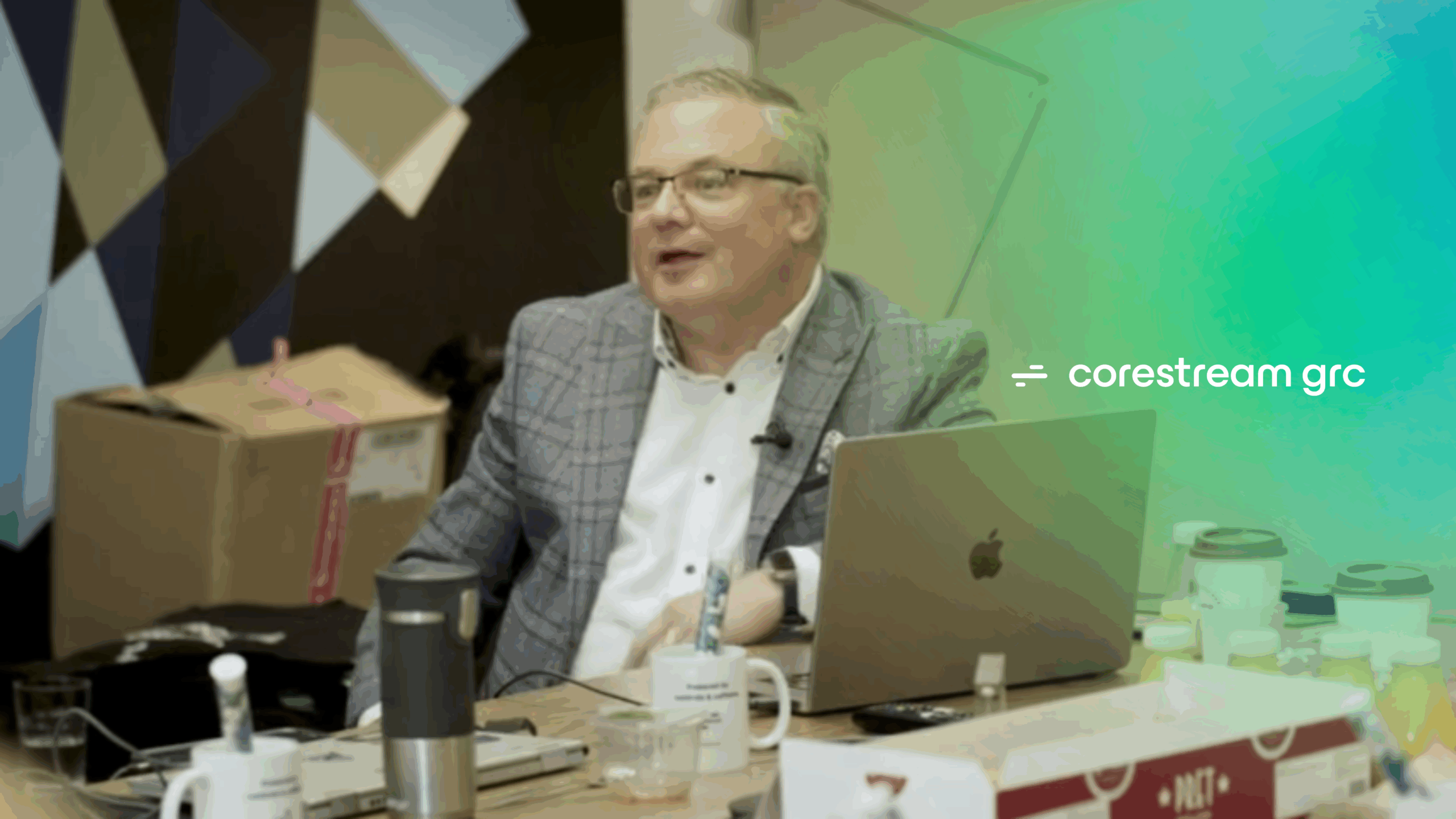
When the GRC Strategy Director at CoreStream GRC, spoke at this year’s UK customer community forum, his focus wasn’t on tools or checklists, it was on value. He challenged the room to rethink governance, risk and compliance, as something which drives better decisions, not just manages risk.

“It’s not about avoiding the downside. It’s about driving better business outcomes.”
Paul Cadwallader, GRC Strategy Director at CoreStream GRC
That idea, value-based GRC, became the thread running through the session, sparking a wider conversation about how organizations can make governance truly meaningful.
If you missed the event, you can read the highlights from our Chief Product Officer.
If you are part of our private customer community, and would like access to the presentation recording, please fill in this form, and marketing will be in touch with the private link.
How to turn GRC from oversight to advantage
1. Redefining GRC
When Paul spoke about value-based GRC, he began by reframing what GRC actually means in practice.
At it’s core, it it is the capability to;
- Reliably achieve objectives – this is governance
- Address uncertainty – this is risk
- Act with integrity – this is compliance
In Paul’s words, GRC should help organizations reach their goals confidently, not just report on what went wrong;
“If your GRC isn’t improving decision-making, it’s just admin.”
He pointed out that in CoreStream GRC’s recent survey, 33% of teams defined success as risk reduction and 27% as regulatory compliance, while only 1 in 5 linked GRC directly to business value creation. That gap, he said, shows why redefining GRC is essential to move from a “defensive” mindset to one that drives outcomes.
This mindset has shaped how CoreStream GRC has built its platform. At CoreStream GRC, we focus on clarity and outcomes, rather than process for process’ sake.
In action: turning static risk reports into real-time business intelligence
One nation-wide retail client used CoreStream GRC’s Risk Management solution to connect controls directly to performance metrics.
The result? A 60-page static risk report became a live, interactive dashboard that their board uses proactively to make decisions.
2. Trust through transparency
At CoreStream GRC, the real measure of good governance is not the amount you document. It is about how much your stakeholders trust you.
Value-based GRC creates this trust by showing the ‘how’ and ‘why’ decisions are made. It is the difference between simple compliance reporting and genuine accountability.
As our GRC Strategy Director puts it;
“GRC professionals shouldn’t be seen as gatekeepers. They’re growth and profit partners.”
That shift is already happening. In CoreStream GRC’s research, executive engagement ranked among the top 3 barriers to GRC maturity, showing how vital transparency is in turning governance from oversight into ownership.
In action: embedding GRC dashboards to strengthen executive trust
One financial services client embedded CoreStream GRC dashboards directly into their monthly executive reviews. Suddenly, risk data wasn’t something to interpret later, it was part of the decision-making conversation in real time.
The result? More informed meetings, fewer escalations and faster consensus at board level.
The takeaway: transparency through GRC turns governance into a business advantage
Transparency, accountability, and efficiency don’t just build confidence, they also prove that governance adds value.
3. Integration and its importance
Paul was clear that the key to value-based GRC isn’t a new framework, it’s integration.
When governance, risk and compliance operate in silos, valuable insight gets lost between spreadsheets, systems and teams. True value comes when everything connects, when objectives, risks, controls and issues all sit within one ecosystem.
“It’s not about avoiding surprises. It’s about knowing what’s coming and acting before it hits.”
That’s why integration is built into the DNA of CoreStream GRC, as we want to support in your mission to achieving a single source of truth for your data. It allows organizations to see relationships between risks and controls instantly. This helps leaders understand not just what’s happening, but why.
In action: connecting existing systems to create a single source of truth
During the session, Paul highlighted how most organizations already have the data they need, it’s just scattered across systems that don’t talk to each other. He shared an example of a CoreStream GRC client who linked their HR, finance, and operational systems directly into CoreStream’s platform.
By automating these connections, the organization eliminated duplicate data entry, reduced reporting delays, and gained a single source of truth for risk and compliance data.
As Paul put it:
“Integration isn’t about reinventing the wheel. It’s about connecting what already exists so you can see the full picture.”
Within months, the client could see live relationships between their people, processes, and risks helping leaders act faster and with more confidence.
And it’s not just infrastructure. At Pets at Home, teams are using CoreStream GRC integrations to link AI-driven risk insights directly with policy management, giving staff real-time guidance without leaving their workflows.
The takeaway: integration turns fragmented data into strategic insight
When data, processes and people align, governance moves from reactive reporting to proactive insight. This is where its real value begins.

4. Measure GRC success by outcomes
Counting the number of controls or policies in place doesn’t tell you whether governance is working. The real measure of success is how GRC changes behavior and outcomes across the organization.
As Paul explains;
“You can’t show value if all you measure is activity.”
A value-based approach looks at the difference governance makes, in decision quality, risk reduction, efficiency, and confidence.
- Better decision making with real-time GRC data integration
CoreStream GRC retail sector case study
One of our clients reached 98-100% control compliance after replacing spreadsheets with CoreStream GRC’s controls module, giving leaders real-time data to act on instead of static reports.
- Reducing compliance risk through automated workflows
CoreStream GRC healthcare sector case study
UNT health aligned compliance workflows to their value of “Courageous Integrity,” allowing early escalation of higher-risk issues and faster, clearer interventions.
- Driving efficiency through policy simplification and connected governance
CoreStream GRC Multinational enterprise example
One enterprise consolidated over 15,000 policies into 750, creating a system focused on the “things that matter”. This is proof that GRC can drive cultural and operational value, not just oversight.
Each of these outcomes connects governance activity directly to business performance. Proof that when done well, GRC delivers measurable value.
The takeaway: measure governance by impact, not activity
Use metrics that link GRC outcomes to real business results, such as decisions made faster, risks managed smarter and leadership confidence that’s earned, not assumed.
5. Start small, prove value, build scale
Big visions often start small.
Paul Cadwallader encouraged teams to think long term. He challenged them to sketch out their ideal GRC architecture, even a five-year vision of how governance, risk and compliance will connect across the business. But he was clear that success begins with focus.
“Start with what will prove value the fastest, not what’s most complex.”
That mindset underpins how CoreStream GRC delivers transformation: block-by-block rollouts that prove impact early and scale naturally.
Many organizations begin with one use case. It’s an approach that keeps momentum high, stakeholder confidence strong, and outcomes measurable from day one.
In action: phased GRC implementation for faster results
One enterprise client adopted CoreStream GRC in focused stages; beginning with a single use case for policy management. Within weeks, automated workflows replaced manual tracking, freeing up hours of administrative effort.
Once that early success was proven, additional modules for risk and incident management were added, creating a connected framework over time.
The result? High adoption, quick wins, and measurable value from day one.
The takeaway: scalable GRC starts with early impact
Build your vision, but deliver it in stages. Quick wins create trust and then trust creates the space to scale.
Multinational enterprise example
One of the strongest examples of value-based GRC in action came from Siemens, a transformation Paul Cadwallader worked on during his time at Deloitte.
Following high-profile compliance challenges, Siemens recognized the need to simplify and reconnect its governance processes. The company restructured more than 15,000 policies into just 750. Isolating the “things that matter.”
That shift did more than tidy documentation. It created clarity, accountability, and a self-reporting culture. It is proof that when governance focuses on what’s truly material, it can unlock efficiency and rebuild trust across a global organization.
Takeaway from this successful integrated GRC model
Simplify, standardize and connect. Governance delivers real value when it focuses on what drives performance not just on what ticks the box.
Looking ahead: GRC as a strategic intelligence layer
The next evolution of GRC is already emerging and is one driven by agentic AI.
Paul Cadwallader described a future where systems can detect risks in real time, simulate outcomes and recommend preventive action before issues escalate.
It’s a shift from governance as documentation to governance as intelligence with Ai as a partner that keeps the business one step ahead of risk.
That’s the direction we’re moving in at CoreStream GRC: a platform evolving from managing governance to measuring integrity, using data and automation to turn insight into action.
To explore how AI is reshaping risk and compliance at CoreStream GRC
Closing
“GRC isn’t about control for control’s sake. It’s about helping your business achieve its objectives with confidence, integrity and speed.”
Paul Cadwallader, Head of GRC Strategy, CoreStream GRC
Value-based GRC is about more than frameworks, it’s a mindset shift. It turns governance into something people believe in, not just comply with. When done right, it builds trust, sharpens decisions, and gives organizations the confidence to grow responsibly.
At CoreStream GRC, that’s the goal: making governance meaningful, measurable, and built around integrity.
Frequently asked questions
Value-based GRC is an approach that connects governance, risk, and compliance directly to business outcomes. Instead of focusing only on risk avoidance or regulatory checklists, it’s about using GRC to improve decision-making, performance, and trust across the organization. As Paul Cadwallader, CoreStream GRC, explained, “It’s not about avoiding the downside. It’s about driving better business outcomes.”
Because most organizations still see GRC as administrative rather than strategic. CoreStream GRC’s survey showed that while 33% of teams define success as “risk reduction,” only one in five connect GRC directly to business value. Redefining GRC means moving from defensive compliance to proactive performance. It helps businesses align governance with their core goals—achieving objectives, addressing uncertainty, and acting with integrity.
A standout case comes from Siemens, who worked alongside CoreStream GRC and restructured more than 15,000 policies into just 750. The result wasn’t just tidier governance—it created clarity, accountability, and a culture of self-reporting. It’s proof that when governance focuses on what’s truly material, it unlocks efficiency, trust, and long-term business value.