
Enter your details and we’ll email you the Third Party Risk RFP template:
This form may not be visible due to adblockers, or JavaScript not being enabled.
For a lot of organizations, the search for Third-Party Risk Management software starts when the current process stops giving the team a reliable view of risk.
Maybe supplier onboarding still runs through email chains, spreadsheets, shared folders, and disconnected questionnaires. Maybe due diligence happens before a contract is signed, but no one has a clear process for checking whether the risk profile changes six months later. Maybe the business knows who its direct suppliers are, but has limited visibility into sub-processors, subcontractors, and other fourth-party dependencies.
The problem is not usually a lack of information.
It is that the information sits in too many different places.
Procurement holds the supplier record. Legal holds the contract. Information security runs cyber assessments. Compliance checks sanctions and adverse media. Data privacy teams track processing activities and sub-processors. Relationship owners monitor performance. Internal audit asks for evidence.
When those processes are disconnected, even simple questions become difficult to answer:
- Which third parties create the most risk?
- Which critical suppliers have overdue assessments?
- Has a vendor’s cyber-risk profile changed since onboarding?
- Which suppliers process sensitive data?
- Are several business services dependent on the same cloud provider or sub-contractor?
- Can we prove that high-risk issues were escalated and remediated?
- What happens if a critical supplier fails tomorrow?
That is usually the breaking point.
What looked like a manageable administrative process becomes a wider governance problem.
And the stakes are real. A 2025 Data Breach Investigations Report found third-party involvement in 30% of the breaches analyzed, up from roughly 15% the previous year.
A point-in-time questionnaire is no longer enough.
Organizations need a connected, evidence-led Third-Party Risk Management process that helps them identify, evaluate, assess, monitor, report on, and eventually offboard third parties throughout the full lifecycle.
“Third-party risk is important… in particular, the layers, you’ve got 4th party, 5th party, etc. And it’s understanding all those different relationships that might impact you in your organization that you don’t naturally have line of sight to.”
Rita Parmar, Senior Risk Officer at UK Bank
Why this Third-Party Risk Management software RFP helps
The Third-Party Risk Management software market can be difficult to navigate.
At a high level, most vendors appear to offer similar capabilities: vendor onboarding, questionnaires, scoring, workflows, dashboards, and reporting.
The differences often become clear later.
A platform may work well during a polished demo but struggle when the organization needs to integrate supplier data from several systems, run different due-diligence pathways by risk tier, track beneficial ownership, connect intelligence feeds, map fourth-party dependencies, evidence remediation, or produce regulator-ready reports.
By that point, the organization has already invested time, budget, and internal resources into implementation.
A stronger RFP helps teams ask the difficult questions earlier.
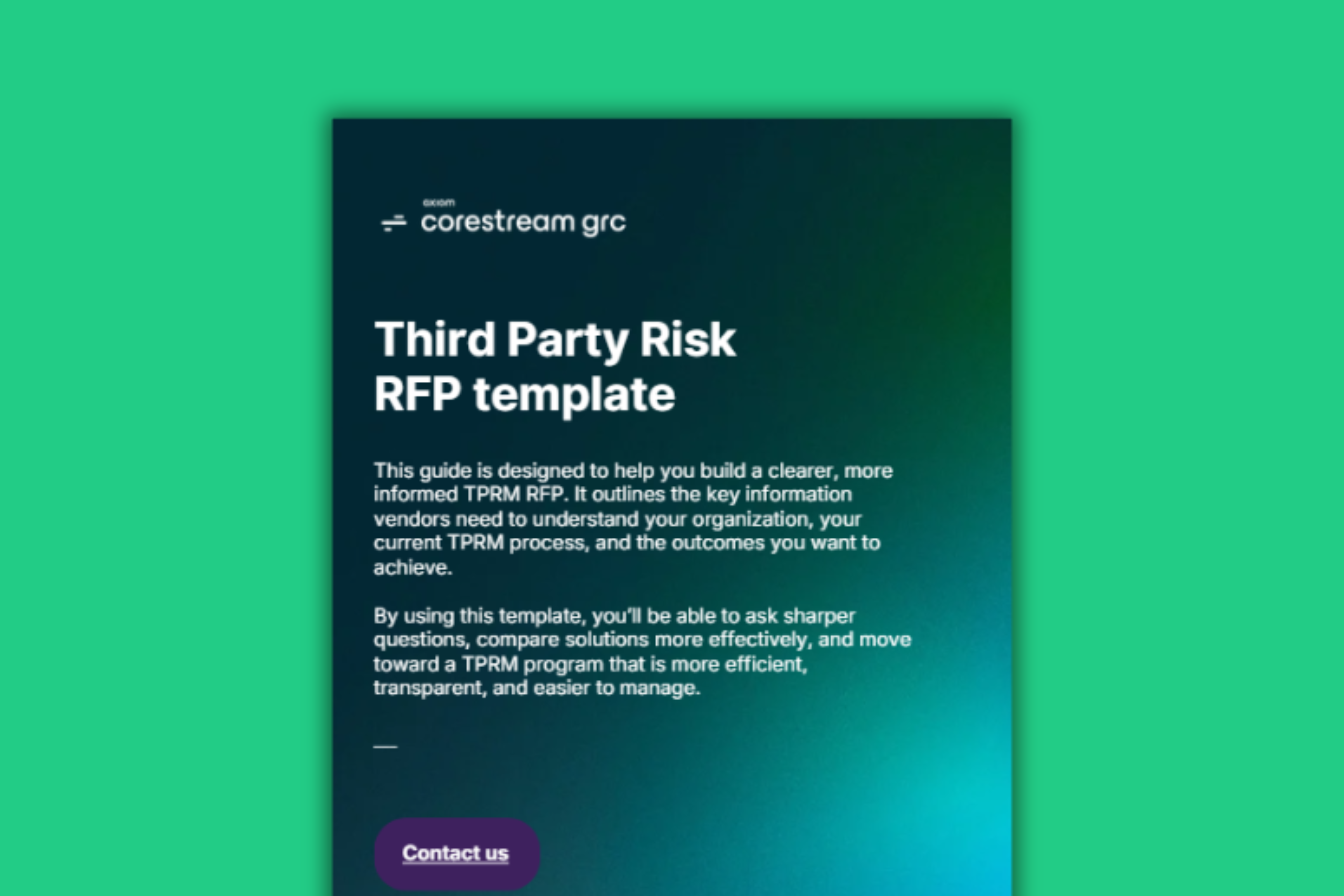
CoreStream GRC’s Third-Party Risk Management RFP template is designed to help risk, compliance, procurement, security, legal, and internal audit teams run a more structured and defensible evaluation process.
It pushes the conversation beyond feature lists.
Instead of asking whether a vendor “supports integrations,” the template asks whether it provides documented REST APIs, real-time webhooks, bulk import and export options, pre-built connectors, configurable data models, and links to external risk-intelligence providers.
Instead of asking whether a vendor “supports due diligence,” it tests whether the platform can run tiered assessment pathways, reuse prior questionnaire answers, ingest evidence, summarize uploaded documents, screen beneficial owners, trigger enhanced due diligence, and continuously reassess risk when material events occur.
The goal is simple: make it harder for vague claims to survive the procurement process.
What you get in our Third-Party Risk Management software RFP template
Inside the template, you will find a structured set of copy-ready questions and scoring prompts to help you compare vendors more consistently.
The template includes:
- 145 Third-Party Risk Management software RFP questions
- A structured vendor-comparison framework
- Priority scoring to separate must-have requirements from should-have and could-have capabilities
- Questions covering operational workflows, governance, security, integrations, data protection, scalability, implementation, and long-term support
- Prompts that help you challenge vendors on how their platform works in practice, not simply whether a feature exists
- A framework that can be adapted to your organization’s sector, regulatory exposure, risk appetite, and supplier ecosystem
The template covers the entire Third-Party Risk Management lifecycle:
Intake → tiering → due diligence → decision-making → contracting → monitoring → remediation → offboarding
A sample of what the Third-Party Risk Management RFP covers
Integrated governance and Enterprise Risk Management
- Can Third-Party Risk Management sit within a broader Enterprise Risk Management framework?
- Can roles, responsibilities, governance frameworks, and approval processes be embedded directly into the platform?
- Can supplier risks, controls, incidents, audits, compliance obligations, and remediation actions be connected?
Third-party onboarding and intake
- Can business users submit new third-party engagement requests through configurable forms?
- Can conditional logic change questions based on spend, geography, data sensitivity, or engagement type?
- Can the system detect duplicate supplier records?
Inherent-risk assessment and tiering
- Can inherent-risk scores be calculated automatically?
- Can administrators configure scoring weights, thresholds, and risk tiers without vendor support?
- Can different due-diligence pathways be triggered for low-, medium-, and high-risk suppliers?
Due diligence and questionnaires
- Does the platform include questionnaire templates aligned to recognized standards such as SIG, CAIQ, NIST CSF, ISO 27001, ISO 27036, DORA, NIS2, SOC 2, GDPR, and OFAC requirements?
- Can administrators configure and version their own questionnaires without code?
- Can suppliers upload evidence and supporting documents?
Enhanced due diligence and screening
- Can suppliers be screened against sanctions, politically exposed person lists, adverse media, and watchlists?
- Can enhanced due diligence be triggered for high-risk vendors, high-risk jurisdictions, and complex ownership structures?
- Can the platform identify and screen ultimate beneficial owners?
Residual risk, findings, and remediation
- Can residual risk be calculated across different risk domains?
- Can findings be raised against specific questions, controls, or evidence gaps?
- Can remediation plans include owners, deadlines, milestones, supporting evidence, approvals, and escalation workflows?
Contract and obligation management
- Can contracts be linked directly to supplier records and risk assessments?
- Can the platform extract key obligations such as service levels, audit rights, data locations, exit provisions, and notification timeframes?
- Can renewal and expiry dates trigger alerts?
Continuous monitoring
- Can external risk-intelligence feeds be integrated into the platform?
- Can the organization combine cyber ratings, financial-health data, sanctions information, adverse-media monitoring, ESG data, geopolitical risks, and breach intelligence?
- Can material-risk events trigger alerts?
Fourth-party and supply-chain visibility
- Can third-party relationships be mapped beyond direct suppliers?
- Can suppliers disclose and update their own sub-processors and sub-contractors?
- Can the platform identify hidden dependencies across critical services?
Resilience, business continuity, and exit planning
- Can business-continuity and disaster-recovery evidence be stored against supplier records?
- Can suppliers be mapped to internal business services?
- Can exit and substitutability plans be documented for critical vendors?
Vendor performance and relationship management
- Can relationship owners schedule and record structured supplier-performance reviews?
- Can service-level agreement and key-performance-indicator data be linked to risk records?
- Can suppliers submit metrics and evidence directly through a portal?
Offboarding and termination
- Can the organization run a structured offboarding workflow?
- Can the platform track access revocation, data return, destruction, and final attestations?
- Can historic records be retained in line with internal policies?
Reporting, dashboards, and analytics
- Can teams track trends in risk movement, findings, assessment-cycle times, and questionnaire completion?
- Can reports drill down from portfolio-level risk to an individual supplier, assessment, finding, or evidence record?
- Can the platform produce regulator-ready outputs, including DORA registers of information?
AI and automation
- Can AI help reviewers evaluate questionnaire responses and surface inconsistencies?
- Can uploaded evidence documents and past assessments be summarized?
- Can users see the provenance and confidence level of AI-generated outputs?
Security and data protection
- Does the vendor hold ISO 27001 certification and a recent SOC 2 Type II report?
- Is data encrypted at rest and in transit?
- Does the platform support single sign-on, multi-factor authentication, and fine-grained role-based permissions?
Implementation and long-term support
- Can the vendor provide a realistic implementation plan?
- Can historic supplier records, contracts, and assessments be migrated from existing systems?
- Is role-based training available for administrators, assessors, business users, and third parties?
Who this Third-Party Risk Management RFP template is for
This template is built for:
- Risk and compliance teams managing third-party risk
- Procurement teams responsible for supplier selection and onboarding
- Information-security and cyber-risk teams evaluating external dependencies
- Data-protection teams assessing suppliers and sub-processors
- Legal teams reviewing contracts, obligations, and risk acceptance
- Internal audit teams that need exportable evidence and clear audit trails
- Operational-resilience teams mapping critical suppliers to business services
- Organizations replacing spreadsheets, inboxes, point solutions, or disconnected systems with a more integrated approach

What should you look for when evaluating Third-Party Risk Management software?
1) A complete third-party lifecycle, not a point-in-time questionnaire
A vendor-risk questionnaire is useful. It is not a Third-Party Risk Management program.
Risk does not stop changing when a questionnaire is submitted or a contract is signed.
A strong platform should support onboarding, tiering, due diligence, decisions, contracting, monitoring, issue management, remediation, reassessment, performance reviews, and offboarding.
It should also be able to trigger action when circumstances change.
For example, if a vendor suffers a breach, receives a cyber-rating downgrade, appears on a sanctions list, or introduces a new sub-processor, the platform should help the organization identify the impact and launch the right response.
2) Risk-based due diligence that reduces unnecessary work
Not every supplier creates the same level of risk.
A catering provider should not automatically receive the same due-diligence questionnaire as a cloud provider processing sensitive customer data.
Strong Third-Party Risk Management software should calculate inherent risk from intake data and route suppliers into proportionate assessment pathways.
That could mean a light-touch review for lower-risk vendors, a standard assessment for medium-risk relationships, and enhanced due diligence for critical suppliers, high-risk jurisdictions, or complex ownership structures.
The objective is not to ask more questions.
It is to ask the right questions, in the right context, at the right time.
3) Continuous monitoring that identifies changes early
Third-party due diligence cannot be treated as a one-off exercise.
A supplier that looked low-risk last year may have experienced a breach, financial decline, ownership change, regulatory investigation, or negative media coverage since its last review.
Look for Third-Party Risk Management software that integrates risk-intelligence feeds and supports event-driven reassessments.
Relevant feeds may include:
- Cyber-security ratings
- Financial-health data
- Sanctions screening
- Politically exposed person screening
- Adverse-media monitoring
- ESG data
- Geopolitical intelligence
- Breach disclosures
- Litigation and court records
The platform should bring those signals into one view and help the team understand which events require action.
4) Third-party risk management integrations that reduce blind spots
Integrations are not an optional technical extra.
They are central to how Third-Party Risk Management works in practice.
Supplier risk sits across the organization. It touches procurement, contracts, privacy, cyber security, business continuity, compliance, finance, identity management, and enterprise risk.
If your Third-Party Risk Management platform operates as a standalone silo, your team will spend too much time moving information between systems and trying to reconcile conflicting records.
Your RFP should test whether the platform can connect with the wider technology environment through:
- Documented and versioned REST APIs
- Webhooks and event streaming
- Bulk import and export tools
- Pre-built enterprise connectors
- External risk-intelligence integrations
- Single sign-on and identity-management integrations
- Reporting and business-intelligence integrations
Depending on your technology stack, relevant vendor-risk management integrations may include:
- Procurement software integrations: SAP Ariba and Coupa
- Workflow and service-management integrations: ServiceNow and Jira
- Human-resources integrations: Workday
- Identity and access-management integrations: Microsoft Entra ID, Okta Workflows, SailPoint, and Saviynt
- CRM integrations: Salesforce
- Collaboration integrations: Microsoft Teams and Slack
- Cyber-risk integrations: BitSight, SecurityScorecard, and RiskRecon
- Financial-risk and due-diligence integrations: Dun & Bradstreet, Refinitiv, and Dow Jones
- ESG-risk integrations: RepRisk and Sustainalytics
- Reporting integrations: Microsoft Power BI and other business-intelligence tools
- Security-monitoring integrations: SIEM tools for centralized log monitoring
A connected Third-Party Risk Management platform should not simply collect more data.
It should help turn fragmented data into usable evidence.
5) Visibility into fourth parties and concentration risk
Your organization may contract with a supplier directly, but the real risk may sit further down the chain.
A critical supplier might rely on a cloud platform, sub-processor, telecoms provider, software library, or specialized subcontractor that also supports several other vendors across your portfolio.
That creates hidden concentration risk.
Strong Third-Party Risk Management software should help teams map fourth parties, sub-processors, subcontractors, critical services, shared infrastructure, and geographic dependencies.
This matters even more in regulated sectors.
For financial-services organizations, DORA has increased the focus on ICT third-party risk, critical providers, sub-contracting chains, concentration risk, and registers of information.
The practical question is no longer just: “Do we know our suppliers?”
It is: “Do we understand the chain of dependencies behind the services we rely on?”
6) Evidence that remains easy to find under pressure
A good process should be easy to prove.
Your Third-Party Risk Management platform should maintain a clear evidence trail across:
- Intake submissions
- Risk-tier decisions
- Manual overrides
- Questionnaire responses
- Supporting documents
- Reviewer comments
- Approval decisions
- Risk acceptances
- Remediation actions
- Contract obligations
- Reassessments
- Performance reviews
- Incident records
- Offboarding actions
When internal audit, a regulator, or senior leadership asks what happened, the team should not have to reconstruct the story from inboxes and spreadsheets.
7) Configurability without constant vendor dependency
Third-party risk programs evolve.
Risk methodologies change. Regulations change. Supplier categories change. Approval routes change. New business units and jurisdictions come into scope.
Routine updates should not require a paid services engagement every time.
Look for no-code or low-code configuration options that allow internal administrators to change forms, questionnaires, scoring methods, risk tiers, notifications, workflows, dashboards, and data structures.
The platform should flex around your operating model, not force your organization into a rigid template.
8) AI that supports judgment rather than replacing it
AI can reduce manual review time, particularly where teams need to assess long documents such as SOC 2 reports, policies, penetration-test summaries, and historic questionnaires.
But speed is not enough.
Organizations should test whether AI-generated outputs are explainable, reviewable, and subject to human oversight.
Ask:
- Can reviewers see where the answer came from?
- Is a confidence score provided?
- Can an output be challenged or overridden?
- Can the client control whether its data is used to train models?
- Is the platform clear about when AI has been used?
AI should help reviewers focus their attention.
It should not create a new evidence gap.
9) Security controls that match the sensitivity of the data
A Third-Party Risk Management system may store contracts, security assessments, supplier records, beneficial-ownership information, data-protection documents, incidents, and remediation plans.
That information needs to be protected properly.
Baseline requirements should include encryption, multi-factor authentication, single sign-on, role-based permissions, audit logs, data-residency options, penetration testing, tenant segregation, disaster-recovery testing, and security-incident notification processes.
Security should be assessed as part of the buying decision, not after the shortlist has already been agreed.
10) Delivery capability, not just product claims
Technology is only part of the decision.
A vendor may have an impressive feature list but still struggle to deliver a practical implementation.
Your RFP should assess:
- Implementation methodology
- Migration support
- Testing environments
- Configuration management
- Training
- Go-live support
- Critical-incident response
- Service-level agreements
- Product roadmap
- Long-term account management
- Pricing transparency
- Data portability and exit support
The question is not simply whether the software works.
It is whether the vendor can help your organization make it work in practice.
Why do teams use an RFP to select Third-Party Risk Management software?
The point of a Third-Party Risk Management RFP is not to create more paperwork.
It is to make the buying process more difficult to game.
A structured RFP helps organizations compare vendors against the same operational, technical, security, and governance requirements.
It also exposes gaps early.
Instead of discovering after implementation that a platform cannot integrate with your procurement system, cannot map fourth-party dependencies, cannot trigger reassessments, or cannot provide clean audit evidence, you can test those requirements before committing.
That gives procurement, risk, compliance, legal, security, and audit teams a stronger basis for making a decision.
Why choose CoreStream GRC for Third-Party Risk Management?
Third-party risk should not sit in a silo.
It should connect to the wider governance, risk, and compliance environment.
CoreStream GRC helps organizations manage Third-Party Risk Management through a flexible, configurable platform that connects supplier records with risks, controls, incidents, audits, obligations, findings, remediation actions, and supporting evidence.
The platform is built to support a more connected view of risk across the entire third-party lifecycle:
Identify. Evaluate. Assess. Monitor. Report. Offboard.
Key benefits include:
- Configurable intake, onboarding, and risk-tiering workflows
- Risk-based due diligence and assessment pathways
- Continuous-monitoring capabilities
- Connected supplier, fourth-party, control, issue, and evidence records
- Flexible integrations with enterprise systems and intelligence providers
- Role-based dashboards and reporting
- Clear audit trails
- No-code configuration
- Support for resilience, contract, remediation, and offboarding workflows
- A wider integrated GRC platform that helps reduce silos
The real question is not whether your organization can collect another supplier questionnaire.
It is whether you can see where risk sits, act when it changes, and prove that the process worked.
Enter your details and we’ll email you the Third Party Risk RFP template:
This form may not be visible due to adblockers, or JavaScript not being enabled.
FAQ on Third-Party Risk Management software
Third-Party Risk Management software helps organizations identify, assess, monitor, and manage risks created by suppliers, vendors, contractors, service providers, and other external relationships.
A strong platform supports the full lifecycle, including intake, inherent-risk assessment, due diligence, risk tiering, screening, remediation, ongoing monitoring, reporting, contract management, and offboarding.
Fourth-party risk is the risk created by suppliers, sub-processors, subcontractors, or service providers used by one of your direct third parties.
For example, your organization may rely on a software provider that hosts its service through a separate cloud platform. That cloud provider is a fourth party.
Mapping these dependencies helps organizations identify concentration risk and hidden exposure across critical services.
Continuous monitoring is the process of tracking changes in a supplier’s risk profile after the initial assessment.
It may include cyber ratings, sanctions, adverse media, financial health, geopolitical risk, ESG data, breach disclosures, regulatory action, and ownership changes.
A strong platform should help teams identify material events, determine which suppliers are affected, and trigger reassessment or remediation when needed.
Spreadsheets can work when supplier volumes and requirements are limited.
As the organization grows, manual processes become harder to manage. Teams may struggle to track assessment status, maintain consistent scoring, apply approval rules, identify overdue actions, connect evidence, monitor changing risks, and respond quickly to audit requests.
Dedicated Third-Party Risk Management software creates a more structured, scalable, and defensible process.
Third-Party Risk Management software can help financial-services organizations manage several practical aspects of DORA readiness.
Relevant capabilities include ICT third-party records, registers of information, sub-contractor-chain visibility, risk assessment, concentration-risk analysis, incident records, resilience evidence, contract obligations, continuous monitoring, and exit planning.
The platform should support the organization’s compliance process, but it does not replace legal or regulatory advice.
Organizations should use a consistent scoring framework.
Essential requirements can be marked as must-have criteria. Important but non-critical capabilities can be scored as should-have requirements. Additional features can be treated as could-have options.
Teams should also ask vendors to demonstrate how key capabilities work using realistic workflows, screenshots, sample exports, integration documentation, security evidence, and implementation plans.
The point of a Third-Party Risk Management RFP is not to create more paperwork.
It is to make the buying process more difficult to game.
A structured RFP helps organizations compare vendors against the same operational, technical, security, and governance requirements.
It also exposes gaps early.
Instead of discovering after implementation that a platform cannot integrate with your procurement system, cannot map fourth-party dependencies, cannot trigger reassessments, or cannot provide clean audit evidence, you can test those requirements before committing.
That gives procurement, risk, compliance, legal, security, and audit teams a stronger basis for making a decision.