
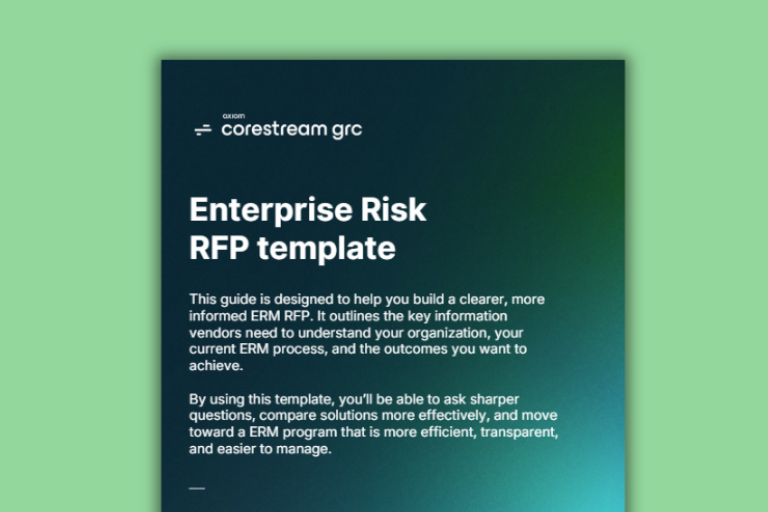
Enter your details and we’ll email you the Enterprise Risk RFP template:
This form may not be visible due to adblockers, or JavaScript not being enabled.
Why do organizations invest in Enterprise Risk Management software?
Despite increasing regulatory pressure and growing organizational complexity, many businesses still rely on manual processes to manage enterprise risk.
Sticking to manual processes, often results in:
- Limited visibility
- Inconsistent risk assessments
- Weak accountability
- Inefficient reporting processes
- Increased risk exposure
A risk register isn’t a risk strategy.
Modern Enterprise Risk Management (ERM) platforms connect objectives, risks, controls, incidents and actions within a single framework, giving leaders the insight they need to make better decisions faster.
“Fragmentation allows organizations to produce documentation without producing capability.”
Michael Rasmussen, GRC 20/20 founder
Why download the CoreStream GRC ERM RFP template?
This template helps you evaluate vendors on their ability to:
- Deliver integrated risk management across the organization
- Connect risk, compliance, controls, and assurance activities
- Automate governance processes
- Support board and executive reporting
- Scale with changing business requirements
- Improve visibility, accountability, and resilience
Instead of relying on vendor claims, you’ll have a structured framework for comparing solutions side by side.
What you get in this CoreStream GRC ERM software RFP template
Written by GRC experts based on decades of experience in design and implementation of risk management technology solutions, along with reviewing against market requests. You can leverage insights from 1000s of data points, that make up:
- 148 detailed ERM software RFP questions
- Assess how effectively vendors support governance and risk framework requirements
- Compare capabilities for risk and control assessments
- Understand different reporting functions
- Assess integration capabilities, data protection controls and platform security
- Evaluate implementation approaches, customer support, training and alignment
A sample of what the CoreStream GRC ERM RFP covers
Integrated GRC Architecture & Governance Framework
- Can the platform deliver Enterprise Risk Management as part of a single integrated GRC platform?
- Can users navigate the full traceability chain from objective → process → risk → control → event → action → obligation?
- Can the platform maintain a central, searchable policy register with version control?
Risk Universe, Taxonomy & Register Structure
- Can the platform maintain separate risk registers and a consolidated enterprise risk register?
- Can strategic, operational, cyber, compliance, and emerging risks be managed within a single solution?
- Can risks be escalated through a defined workflow with approval controls?
Risk Identification, Causes & Consequences
- Can the platform maintain central cause and consequence libraries?
- Can the platform generate an interactive bow-tie diagram for each risk?
- Can the platform detect duplicate or overlapping records at the point of entry?
Risk Assessment, Scoring & RCSA
- Can the platform support multiple assessment matrices and scoring methodologies?
- Can the platform support Risk and Control Self-Assessments (RCSA)?
- Can review due dates be calculated automatically?
Risk Appetite, Tolerance & Limits
- Can the platform define risk appetite, capacity, and tolerance at multiple levels?
- Can the platform automatically identify out-of-appetite risks?
- Can the platform report appetite consumption metrics?
Controls & Control Assurance
- Can the platform maintain a dynamic control library?
- Can a single control be linked to multiple risks and obligations?
- Can the platform support control testing and control self-assessments?
Risk Treatment, Actions & Issues
- Can the platform record risk treatment strategies?
- Can actions be linked to target risk scores?
- Can overdue actions be escalated automatically?
Key Risk Indicators & Metrics
- Can the platform maintain libraries of KRI, KCI, and KPI metrics?
- Can threshold breaches trigger alerts and escalations?
- Can historical metric values be retained for trend analysis?
Risk Events, Incidents & Loss Data
- Can the platform support incidents, near misses, and regulatory breaches?
- Can events be linked directly to risks and controls?
- Can the platform record gross, net, and potential loss values?
Assurance Planning & Combined Assurance
- Can the platform maintain an assurance or audit universe?
- Can the platform create annual assurance and audit plans?
- Can findings be linked directly to remediation actions?
Scenario Analysis, Quantification & Emerging Risk
- Can the platform support quantitative risk analysis techniques?
- Can the platform capture scenario definitions and outcomes?
- Can the platform ingest external hazard or market data?
Workflow & Notifications
- Can the platform provide no-code workflow configuration?
- Can workflows be triggered by field changes, dates, and thresholds?
- Can recurring governance activities be scheduled automatically?
Reporting, Dashboards & Board Outputs
- Can the platform provide real-time dashboards and reports?
- Can users drill down from reports to underlying records?
- Can the platform generate board reports from client templates?
Historical Data, Audit Trail & Retention
- Can the platform maintain a field-level audit trail?
- Can users compare historical versions of records?
- Can records be reconstructed as they existed on a specific date?
Security & Data Protection
- Does the vendor hold ISO 27001 certification and SOC 2 Type II?
- Can the platform encrypt data at rest and in transit?
- Can the platform enforce role-based access controls?
Performance, Availability & Resilience
- Can the vendor deliver a minimum 99.5% SLA?
- Can the platform support concurrent assessments at scale?
- Does the vendor operate geographically separated infrastructure?
Integration & Interoperability
- Can the vendor provide an OpenAPI-compliant REST API?
- Can the platform support push, pull, webhook, and file-based integrations?
- Can integrations be configured without custom development?
Configurability & Extensibility
- Can administrators configure workflows and data models without coding?
- Is a sandbox environment available?
- Can configuration changes be promoted between environments?
Usability & Accessibility
- Does the platform provide a modern browser-based user experience?
- Does the platform conform to WCAG 2.1 AA standards?
- Can the platform support mobile and tablet access?
Identity, Access & Tenancy
- Can users be provisioned automatically through SSO or SCIM?
- Can the platform enforce IP allowlisting?
- Can the vendor demonstrate segregation of customer data?
Operational Security
- Can the vendor provide evidence of backup and recovery procedures?
- Can the vendor notify customers of security incidents within a contractual SLA?
- Can planned upgrades be completed without impacting configurations?
Implementation, Support & Commercials
- Can the vendor provide an implementation plan and reference customers?
- Can the vendor support migration from legacy systems?
- Can the vendor provide role-based training and 24×7 support options?
Who this Enterprise Risk Management RFP template is for
This template is built for:
- Chief Risk Officers
- Enterprise Risk Managers
- Governance teams
- Compliance leaders
- Internal Audit teams
- Cyber and Technology Risk teams
- Procurement teams
- Transformation leaders
- Executive stakeholders
It’s particularly valuable to organizations looking to replace spreadsheets, modernize legacy GRC platforms, or establish a more integrated approach to ERM.
What should you look for when evaluating ERM software?
- Strategic alignment
Risk management should start with business objectives.
Your ERM platform should enable risks to be linked directly to strategic goals. Leaders should be able to understand not only what risks exists, but how those risks could impact organizational success.
If risks can’t be connected to strategy, they’re unlikely to influence decisions.
- Connected risk intelligence
Risk doesn’t happen in silos.
A modern ERM platform should connect risks, controls, incidents, policies, findings and actions within a single framework.
This creates traceability and eliminates a fragmented view that often exists when information is spread across spreadsheets and disconnected systems.
- Enterprise-wide visibility
Leadership teams need a complete view of risk exposure.
Look for software that provides visibility across business departments, legal entities and locations while maintaining a consolidated view.
This ability to see relationships, trends and emerging risks is essential for informed decision-making.
- Risk-based decision-making
The best ERM platforms don’t just collect information, they help organizations act on it.
Dashboards, analytics, reporting, and risk insights should support decisions at every level of the business.
Risk management should inform strategy, not just document it.
- Flexibility without complexity
Your organization is unique, and your risk framework should be too.
Look for a configurable solution that will adapt to your terminology, workflows, structures and reporting requirements.
Technology should fit your business, not the other way around.
“We believe technology should be an enabler, not a barrier.”
- Strong accountability
Effective risk management relies on clear ownership.
Your platform should support defined responsibilities, review cycles and action tracking so risk management becomes an active process rather than a periodic exercise.
Accountability should be embedded in every stage of the ERM lifecyle.
- Proactive risk management
Modern ERM is proactive, not reactive.
Organizations shouldn’t have to wait for incidents to identify emerging threats.
The best ERM software helps organizations anticipate risks before they happen.
Why do teams use and RFP to select ERM software?
An ERM software RFP isn’t about creating more paperwork, it’s about making vendor comparisons more objective.
A structured RFP helps you evaluate vendors against the same governance, risk, reporting, security, and technical requirements. It also helps uncover gaps early.
Instead of relying on product demonstrations and vendor claims, you can assess whether a solution can support your risk framework, automate key processes, deliver meaningful reporting, and scale with your business.
That gives stakeholders a stronger basis for making the right decision.
Why choose CoreStream GRC for Enterprise Risk Management software?
Most ERM platforms force you to adapt to their way of working. We believe it should be the other way around.
CoreStream GRC helps organizations move beyond spreadsheets, disconnected risk registers, and static reporting to create a more connected, decision-focused approach to risk management. Our flexible Enterprise Risk Management solution enables you to link objectives, risks, controls, incidents, actions, and assurance activities within a single framework, creating the visibility and accountability needed to make better decisions.
Through Objectives@Risk™, developed in partnership with BRAVE, organizations can go a step further by connecting risk management directly to strategic objectives. Rather than viewing risks in isolation, leaders gain a clearer understanding of how uncertainty, dependencies, controls, and assurance activities influence business outcomes. This objective-centric approach helps boards, executives, and risk leaders focus on what matters most: achieving priorities with confidence.
At Morgan Sindall, a FTSE 250 construction and regeneration group, now runs a single risk register across all divisions, supported by automated updates, approvals, and real-time reporting at the click of a button. The no-code platform was configured to match their existing framework and continues to scale as the organization evolves.
“We wanted something simple and intuitive. CoreStream GRC was the clear choice.”
Ian Ross, Group Head of Audit and Assurance, Morgan Sindall

Unlike rigid, one-size-fits-all platforms, CoreStream GRC is a flexible, no-code platform that adapts to your organization, your processes, and your risk framework.
Enter your details and we’ll email you the Enterprise Risk RFP template:
This form may not be visible due to adblockers, or JavaScript not being enabled.
Frequently asked questions on ERM software
An ERM software RFP (Request for Proposal) is a structured document used to evaluate and compare Enterprise Risk Management solutions. It helps organizations assess vendors against consistent functional, technical, security, reporting, and governance requirements, making it easier to identify the solution that best aligns with their risk management framework.
Look for software that connects objectives, risks, controls, incidents, actions, and assurance activities within a single platform. Key capabilities should include risk assessments, risk appetite management, workflows, reporting, dashboards, action tracking, integrations, audit trails, and configurable governance processes that support your organization’s specific approach to risk management.
Spreadsheets can create version control issues, fragmented reporting, limited visibility, and inconsistent risk management practices. Enterprise Risk Management software provides centralized data, automated workflows, clearer accountability, real-time reporting, and enterprise-wide visibility, helping organizations make better-informed decisions and respond faster to emerging risks.
The best ERM software should align with your risk framework, support strategic decision-making, and scale with your organization. When evaluating solutions, assess how well they support enterprise-wide visibility, risk ownership, reporting, integrations, automation, security, and flexibility. A structured ERM RFP is one of the most effective ways to compare vendors objectively and identify the right fit.