
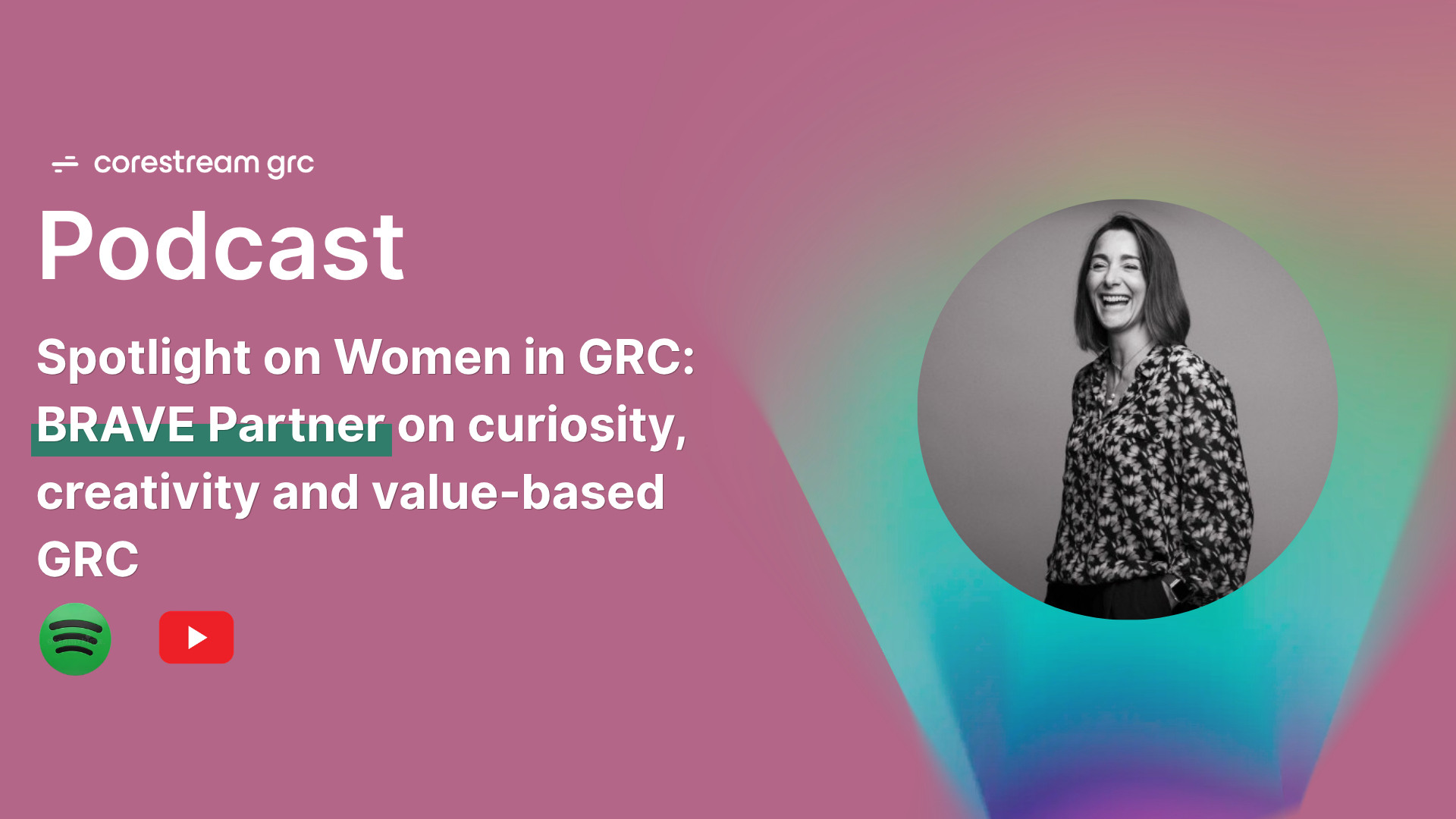
In this episode of CoreStream GRC’s Spotlight on Women in GRC podcast, Lucy Montague sits down with Emma Price, Partner at Brave, former Deloitte partner and one of the UK’s leading voices in risk and resilience.
With more than 25 years of experience helping boards navigate uncertainty, Emma shares:
- Why curiosity is one of the most valuable skills in GRC today
- How enterprise risk management is shifting from risk identification to navigating uncertainty
- What separates strategic, value-driven risk functions from compliance-led approaches
- Why future GRC leaders need influence, judgment and creativity alongside technical expertise
- How women can build influence when they are the only person like them in the room
- The role sponsorship plays in developing future CROs and compliance leaders
- Why diversity of thought strengthen risk decision-making
- How AI is changing the profession and elevating the importance of human skills
Curiosity: The skill that launched a 25-year career in GRC and a competitive advantage for boards
Like many risk leaders, Emma did not set out to build a career in governance, risk and compliance. What attracted her to the profession was something much more fundamental: curiosity.
Working across governance, risk, resilience and strategy allowed her to understand how organizations operate as interconnected systems rather than isolated functions.
“GRC is one of those few disciplines where you are really cross-cutting in an organization. It brings in all those different aspects of strategy, risk, resilience and compliance. You’re kind of right in the centre of the really important business conversations.”
Emma Price, Partner, Brave
That curiosity has remained a constant throughout a career spanning more than 25 years, from industry roles to Big Four leadership and board advisory work. Today, Emma combines several complementary roles that keep her connected to different perspectives on risk and decision-making:
- Building the UK risk and resilience practice at Brave
- Advising industry body Resilience First
- Teaching MBA students at the University of Bath
- Supporting the profession as a Risky Women Ambassador
“Each role gives me a different lens on risk and leadership. Advisory work keeps me close to the challenges executives face, my NED role lets me see those issues from the board’s perspective, industry groups keep me connected to emerging trends, and teaching shows me how the next generation is thinking. They all feed into each other. I learn as much as I teach, and because the roles are mutually reinforcing, it never feels like a heavy workload, I genuinely enjoy it.”
Emma Price, Partner, Brave
Research suggests Emma’s experience is not unusual. LinkedIn’s mentoring research found that:
“Mentors experience significant professional and personal growth through reciprocal learning, including a 28% increase in salary for active mentors, a 6x higher likelihood of being promoted compared to non-mentors, and reported gains in new knowledge and technical skills in up to 20% of mentoring studies.”
Emma Price, Partner, Brave
For Emma, curiosity isn’t just a personal career driver, it is increasingly becoming a strategic advantage for organizations.
When she works with boards that view risk as a business enabler rather than a compliance exercise, she notices one common characteristic: they ask better questions.
Rather than focusing solely on risk reports, dashboards and control metrics, effective boards challenge assumptions, explore alternative scenarios and actively seek to understand what could prevent strategic objectives from being achieved.
“Have we thought creatively about the scenarios that we’re using to predict and make some modelling and thinking around this? Because everything we said wouldn’t happen has probably happened.”
Emma Price, Partner, Brave
For Emma, that means curiosity and creativity are no longer “nice-to-have” leadership traits. They are critical decision-making capabilities. The most effective boards combine robust analysis with the willingness to question assumptions, explore different perspectives and imagine scenarios that may initially seem unlikely.
Enterprise risk management is no longer about risk registers and check lists
One of the biggest changes Emma has observed over the last five years is a shift away from traditional risk registers and toward outcome-focused decision-making.
Historically, many organizations focused on identifying and cataloguing risks individually. That approach is becoming less effective as risks become increasingly interconnected.
“I would summarize it as changing from identifying risks to how do you navigate uncertainty.”
Emma Price, Partner, Brave
The same shift is evident in Emma’s work teaching on the University of Bath MBA programme. Future business leaders are far less interested in risk frameworks and methodologies than previous generations. Instead, they want to understand how risk professionals influence strategic decisions, support growth and help organizations respond to uncertainty.
Today’s organizations face a complex mix of geopolitical instability, emerging technologies, supply chain disruption, cyber threats and economic volatility. Rather than attempting to predict every possible event, Emma believes leaders should focus on the outcomes that matter most and ensure they can continue to deliver them regardless of what happens next.
“We don’t really need to know whether it’s a COVID risk, if it’s a tsunami, if it’s a massive cyber attack. We just need to focus on the priorities for the business and then allocate resources accordingly.”
Emma Price, Partner, Brave
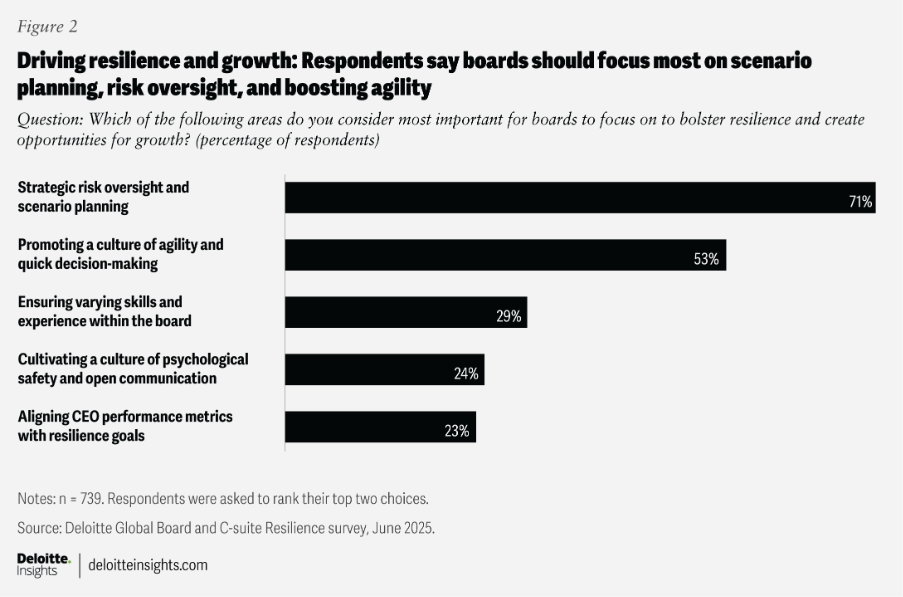
This reflects a broader evolution in enterprise risk management, with increasing emphasis on resilience, scenario planning and organizational adaptability. Deloitte’s research highlights that boards are placing growing focus on resilience-building capabilities, particularly around risk management, preparedness and scenario planning as they navigate an increasingly volatile environment.
The principle also aligns with Emma’s recommendation for Spotlight on Women in GRC listeners: Peter Hinssen’s Never Normal.
For Emma, the book captures a reality that many organizations are only now beginning to embrace:
“Disruption is no longer an occasional event that organizations recover from. It’s actually a permanent operating environment for us all now. Success comes from not trying to predict every change, but from building organizations that are adaptable, they’re always learning and they’re ready to evolve.”
Emma Price, Partner, Brave
Ultimately, the future of enterprise risk management is not about maintaining ever-longer lists of risks. It is about creating leaders and organizations that can adapt, respond and make confident decisions in the face of constant uncertainty.

Women In GRC: Why sponsorship matters more than mentoring
Another important theme Emma highlighted was the persistent lack of women in senior GRC leadership roles. While much of the discussion around gender diversity focuses on recruitment, Emma believes the bigger challenge lies in what happens after women enter the profession.
The issue is often not access to GRC careers, but access to the experiences, visibility and opportunities that prepare people for leadership positions.
Emma points to three critical ingredients for career progression:
- Stretch assignments
- Exposure to executive and board-level decision-making
- Strong sponsorship
“The thing that makes the biggest difference is proper proactive sponsorship.”
Emma Price, Partner, Brave
Unlike mentoring, which typically focuses on advice and guidance, sponsorship is about action. Sponsors actively advocate for individuals, create opportunities and help raise their profile within an organization.
“A proper sponsor will open the doors. They will champion you when you’re not in the room. They will help you find the opportunities.”
Emma Price, Partner, Brave
The need for sponsorship is reflected in broader leadership research. McKinsey & Company found that only 31% of women at entry level report having a sponsor, compared with 45% of men, creating an early career gap that can compound over time.
Emma encourages women not only to seek mentors, but to actively build relationships with sponsors. She credits both female and male sponsors with helping her progress throughout her career and creating opportunities she may not otherwise have accessed.
How to influence when you’re the only woman in the room
Having frequently found herself as the only woman in the room throughout her career, Emma also shared practical advice for anyone looking to build influence and credibility in senior leadership environments.
Her first lesson may surprise some aspiring leaders:
“You don’t need to be loud to be the most influential person in the room.”
Emma Price, Partner, Brave
She argues that “clarity matters more than airtime” and encourages professionals to:
- Speak early in conversations
- Ask strategic questions rather than technical ones
- Connect discussions back to organizational objectives
- Focus on the bigger picture
- Earn and own their place at the table
The goal is not simply to contribute to the conversation, but to shape it.
This advice echoes insights shared by Jaypee Soule, VP of Compliance at PensionBee, on a previous Spotlight on Women in GRC episode. Discussing confidence in senior leadership environments and overcoming imposter syndrome, Jaypee shared:
“One good trick that I use is just to see everyone as a normal person not their position. I don’t think about what influence they have. I just think about them as another human being. And that usually helps to calm the nerves and not worry too much.”
Jaypee Soule, VP Compliance and MLRO, PensionBee
Together, their advice highlights an important leadership lesson: confidence does not come from having all the answers. It comes from bringing valuable perspectives, asking thoughtful questions and trusting that you deserve a seat at the table.
AI will make human skills more valuable, not less
While technology will undoubtedly define the next era of GRC, Emma believes the profession’s future will ultimately depend on distinctly human capabilities.
“AI will give you insight, but it doesn’t provide judgment. It’ll give you data, but there’s no context. It can provide capability, but it can’t give you accountability.”
Emma Price, Partner, Brave
As AI adoption increases, Emma expects organizations to place even greater value on:
- Judgment
- Influence
- Creativity
- Professional courage
- Empathy
- Relationship-building
- Decision-making under uncertainty
Her perspective aligns closely with broader workforce trends. The World Economic Forum identifies analytical thinking, resilience, leadership, creative thinking and curiosity among the most important future skills employers are seeking.
“The human element becomes increasingly important.”
Emma Price, Partner, Brave
Emma’s insight supports ex Chief Risk Officer, and Co-Founder of SANNOS AI, Anders Soberg’s point on human importance when working on AI-powered GRC, from the recent Modern CISO compliance stack webinar:
“It’s the human that sits with the oversight across the organization. AI is intelligence, but it also only knows what it knows. You need a skilled practitioner, someone who knows the organizations and knows the risk to use the data to drive decision. The human is needed, and AI is an enabler for allowing them to actually do more to change and mitigate risk rather than following up on the assurance and evidence of compliance.”
Anders Søborg, Co-Founder, SANNOS
Emma expands on this as she believes risk management benefits enormously from diverse human perspectives because there is rarely one correct answer.
“The more you can bring in different perspectives to make those decisions, the better.”
Emma Price, Partner, Brave
For GRC leaders facing increasingly complex decisions, diversity of thought may be one of the most valuable risk mitigation tools available, alongside shiny new AI solutions.
Conclusion: Value-based GRC starts with better questions
Throughout the conversation, one theme consistently emerged: effective GRC is not about managing risk for its own sake.
Whether discussing boardrooms, enterprise risk management, leadership development or AI, Emma continually returned to a simple question:
What value does this create?
Her approach reflects the growing movement toward value-based GRC, where governance, risk and compliance functions are measured not by the number of controls tested or reports produced, but by their contribution to better decisions, stronger resilience and improved business outcomes.
“With value-based GRC, your organization can achieve more and have greater competitive advantage.”
Paul Cadwallader, GRC Strategy Director, CoreStream GRC
As organizations face an increasingly uncertain future, Emma believes the most successful leaders will be those who combine technology with curiosity, judgment, creativity and courage.
Or, as she puts it:
“Success comes from not trying to predict every change, but from building organizations that are adaptable, they’re always learning and they’re ready to evolve.”
Emma Price, Partner, Brave
Is your business ready?
About Emma Price
Emma Price is a Partner (or “Pioneer”) at Brave, where she helps organizations strengthen risk, resilience and governance capabilities. With more than 25 years of experience spanning industry, advisory and Big Four leadership roles, Emma has built her career helping boards and executives make better decisions under uncertainty. Alongside her work at Brave, she teaches risk management on the University of Bath MBA programme, serves as a Non-Executive Director, contributes to industry initiatives including Resilience First, and acts as a Risky Women Ambassador. Emma is passionate about value-based GRC, organizational resilience and ensuring risk functions play a strategic role in driving business performance.
About the Spotlight on Women in GRC Podcast
Spotlight on Women in GRC is a podcast series created to continue the conversations sparked by the Women in GRC Awards and shine a light on the professionals shaping governance, risk and compliance today. Hosted by CoreStream GRC’s Lucy Montague, the series explores career journeys, leadership lessons and the trends transforming the GRC profession.
Through candid conversations with risk, compliance, audit, resilience, privacy and governance leaders, the series aims to inspire the next generation of GRC professionals while showcasing the diverse experiences and perspectives helping shape the future of the industry.
Frequently Asked Questions About Enterprise Risk Management and GRC Leadership
Value-based GRC focuses on helping organizations achieve strategic objectives rather than simply meeting compliance requirements. It connects governance, risk and compliance activities directly to business outcomes, decision-making and organizational performance.
Curiosity helps risk professionals challenge assumptions, identify emerging risks and understand how different parts of an organization interact. It encourages better questioning, broader thinking and more effective decision-making in uncertain environments.
Enterprise risk management is evolving from static risk registers and compliance-driven processes towards resilience, scenario planning and outcome-focused decision-making. Organizations are increasingly focused on navigating uncertainty rather than attempting to predict every possible risk event.
According to Emma, future GRC leaders will need a combination of technical expertise and human capabilities, including:
Strategic thinking
Influence and communication
Creativity
Judgment
Professional courage
Empathy
Adaptability
Stakeholder management
Mentoring typically focuses on guidance, coaching and advice. Sponsorship goes further by actively creating opportunities, advocating for individuals when they are not in the room and helping them gain visibility with senior decision-makers.
Emma recommends:
Speaking early in discussions
Asking strategic questions
Linking conversations back to business objectives
Focusing on the bigger picture
Building strong sponsorship relationships
Owning your place at the table
Risk decisions rarely have a single correct answer. Diverse teams bring different perspectives, challenge assumptions and help organizations identify risks and opportunities that might otherwise be overlooked.
AI will improve organizations’ ability to analyse data, identify patterns and generate insights. However, Emma believes human capabilities such as judgment, context, accountability, creativity and relationship-building will become even more important as AI adoption increases.
Condensed Transcript of the Episode
Lucy Montague:
Welcome to Spotlight on Women in GRC, a podcast series created to continue the conversations sparked by the Women in GRC Awards 2026. Supported by CoreStream GRC, the series shines a light on the women shaping governance, risk and compliance.
Today I’m joined by Emma Price, Partner at Brave. Emma, thank you for joining us.
Emma Price:
Thanks, Lucy. It’s lovely to be here.

Career Journey
Lucy Montague:
Tell us a little about your role and career journey.
Emma Price:
I’m currently a Partner at Brave, where I’m helping to grow the UK risk and resilience practice.
Looking back, though, my career has really been about helping boards make better decisions under uncertainty. That started in industry before moving into Big Four consulting. Today I do that through a combination of advisory work, teaching MBA students, serving as a Non-Executive Director and contributing to industry initiatives.
The common thread is helping organizations make better decisions.

Why GRC?
Lucy Montague:
What first attracted you to governance, risk and compliance?
Emma Price:
Like many people, I didn’t grow up thinking risk management was a career option.
What attracted me was curiosity. GRC is one of the few disciplines that cuts across every part of an organization. You’re exposed to strategy, risk, resilience, governance and compliance, and you’re often right at the centre of the most important business conversations.
I also became fascinated by understanding why some organizations thrive while others struggle, particularly during periods of crisis and disruption.
The Evolution of Enterprise Risk Management
Lucy Montague:
How has enterprise risk management changed during your career?
Emma Price:
The biggest shift has been moving from identifying risks to navigating uncertainty.
Historically, organizations focused on long lists of individual risks. Today, risks are much more interconnected. Organizations need to think less about specific events and more about protecting the outcomes that matter most.
Rather than asking whether the next disruption will be a cyberattack, a pandemic or a geopolitical event, leaders should ask what outcomes must continue to be delivered regardless.

Risk as a Strategic Advantage
Lucy Montague:
What separates organizations that use risk as a strategic advantage from those that see it as a compliance exercise?
Emma Price:
The best boards ask better questions.
They focus on what’s really going to stop the organization achieving its objectives. They challenge assumptions, examine scenarios and think creatively about future risks.
Good governance isn’t about receiving more information. It’s about understanding what matters most and making better decisions.

Teaching the Next Generation of Leaders
Lucy Montague:
What are MBA students asking about risk today?
Emma Price:
There’s been a huge shift away from frameworks and methodologies.
Students want to know how risk professionals influence decisions, act as strategic advisors and use technologies like AI to create value.
They’re much more interested in business impact than technical process.

Women in GRC Leadership
Lucy Montague:
Why do you think women remain underrepresented in senior GRC leadership roles?
Emma Price:
I don’t think there’s one simple answer.
What often gets overlooked is the journey before someone becomes a Chief Risk Officer or Chief Compliance Officer.
Who receives stretch opportunities? Who gets exposure to boards and executives? Who has sponsors advocating for them?
Those things matter enormously.

Sponsorship vs Mentoring
Lucy Montague:
How can organizations better support women progressing into leadership?
Emma Price:
The biggest difference comes from sponsorship.
Mentoring and coaching are valuable, but sponsors actively open doors. They advocate for you when you’re not in the room and help create opportunities.
That kind of support can have a huge impact on someone’s career progression.

Being the Only Woman in the Room
Lucy Montague:
You’ve often been the only woman in the room. What advice would you give?
Emma Price:
You don’t need to be loud to be the most influential person in the room.
Clarity matters more than airtime.
Speak early, ask strategic questions, connect conversations back to organizational objectives and focus on the bigger picture.
Influence comes from the quality of your contribution, not the volume of your voice.

Taking a Leap of Confidence
Lucy Montague:
Was there a moment in your career when you had to really back yourself?
Emma Price:
Leaving the Big Four was probably the biggest recent example.
After spending many years within those organizations, stepping into a smaller business meant people were engaging with me rather than the brand.
That was uncomfortable at times, but it was also incredibly liberating. It allowed me to rethink how I wanted to contribute and create value.

The Future of GRC
Lucy Montague:
What will define the next era of GRC?
Emma Price:
Technology will clearly be a major factor, particularly AI.
But I think the differentiator will be human judgment.
AI can provide insight, analysis and information. What it cannot provide is accountability, context, empathy or professional judgment.
Those human skills will become increasingly important as technology continues to evolve.

Diversity of Thought
Lucy Montague:
How has life outside work influenced your leadership style?
Emma Price:
I’m a parent to four children, three of whom are neurodivergent.
That experience has taught me there isn’t one way to see the world. Different perspectives often lead to better questions and better outcomes.
I’ve brought that thinking into my professional life. The more diverse perspectives you have around a decision, the stronger that decision is likely to be.

Influences and Recommendations
Lucy Montague:
Are there any books or people who have influenced your thinking?
Emma Price:
One person I’d highly recommend is Peter Hinssen and his book Never Normal.
His core message is that disruption is no longer an occasional event. It’s a permanent operating environment.
Organizations shouldn’t focus on predicting every change. They should focus on becoming adaptable, resilient and ready to evolve.

Lucy Montague:
Emma, thank you so much for joining us and sharing your insights.
Emma Price:
Thank you for having me. I’ve really enjoyed the conversation.
Lucy Montague:
And thank you to everyone listening to Spotlight on Women in GRC. Join us next time for another conversation with the women shaping the future of governance, risk and compliance.