
Key takeaways
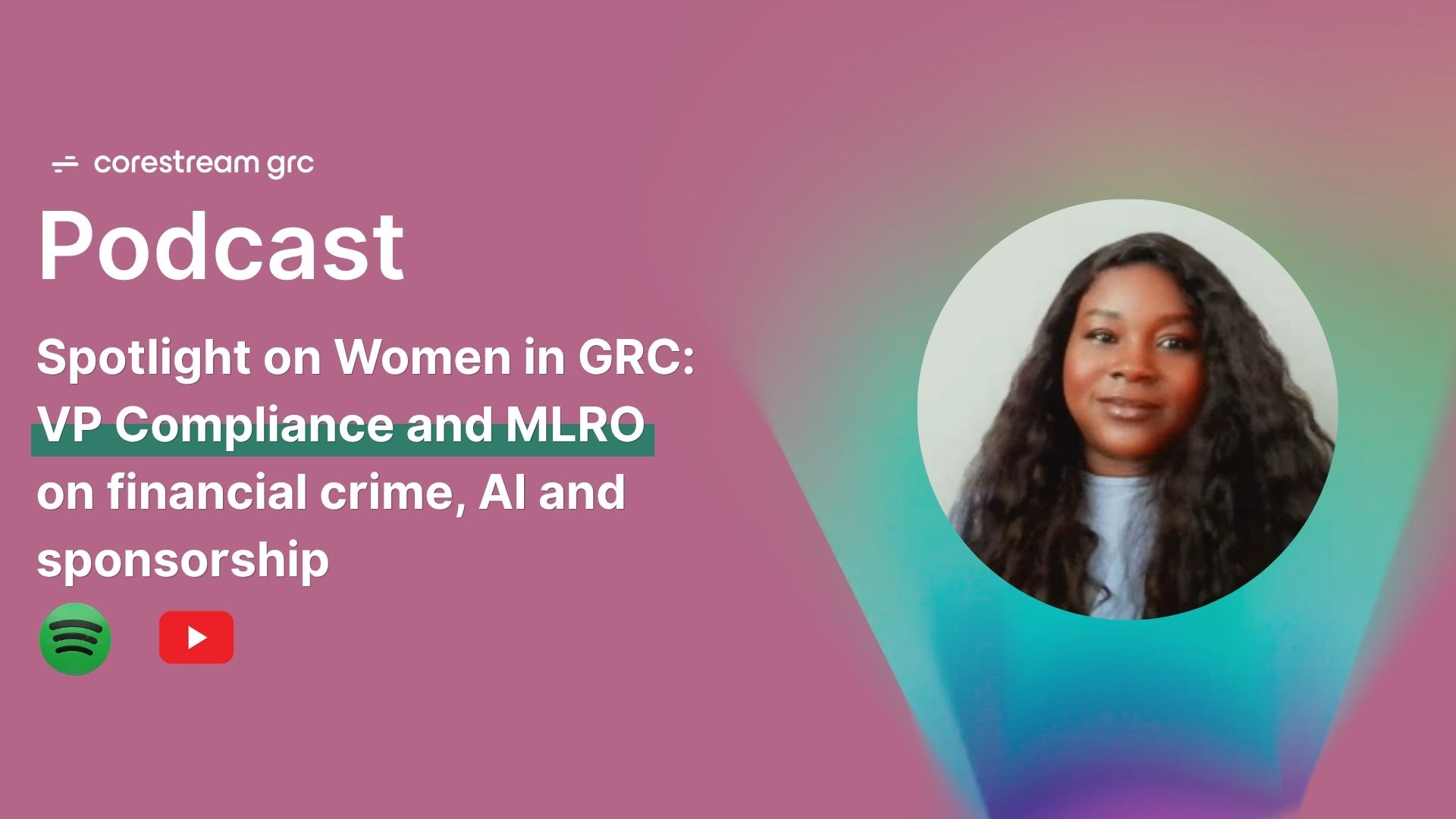
In this episode of CoreStream GRC’s Spotlight on Women in GRC podcast, Lucy Montague speaks with Jaypee Soule, VP Compliance and MLRO at PensionBee.
Jaypee’s route into governance, risk and compliance is grounded in values: integrity, fairness, investigation and the desire to help organizations do things properly.
The conversation explores:
- Why compliance does not have to be cold, strict or unapproachable.
- Why sponsorship matters more than mentorship when women are trying to progress.
- How representation changes what people believe is possible.
- Why AI is reshaping financial crime, fraud, complaints and compliance monitoring.
- Why GRC leaders need to understand technology before it outruns them.
- Why confidence, culture and visible leadership matter for women in GRC.
The message is clear: the next era of compliance leadership will need people who can combine technical knowledge with courage, creativity, commercial awareness and human judgment.
Introduction: compliance leadership is changing
Jaypee Soule has worked in financial services since 2013, beginning her career in retail banking before moving into pension investments. She has now been at PensionBee for 7 years, progressing through the organization into a senior compliance and financial crime leadership role.
As VP of Compliance, Jaypee works across regulatory compliance, policies, procedures and first-line support. As MLRO, she holds the FCA-approved SMF 17 responsibility for money laundering reporting.
“The VP side of my role, VP Compliance, I deal with a lot of regulatory compliance. The MLRO part, which is an SMF 17 role, is the Money Laundering Reporting Officer. It’s my responsibility to make sure that my firm is in compliance with anti-money laundering regulations.”
Jaypee Soule, VP Compliance and MLRO, PensionBee
That role brings together technical responsibility, regulatory accountability and day-to-day judgment. It also places Jaypee at the center of some of the biggest issues facing financial services compliance today: financial crime, fraud, AI, monitoring, culture and senior-level challenge.
What does a VP Compliance and MLRO actually do?
An MLRO role is not just a title. In the UK, SMF 17 under the FCA’s Senior Managers and Certification Regime covers responsibility for the money laundering reporting function.
For Jaypee, the role means making sure the business has the right controls, tools and oversight in place to manage financial crime risk.
“Day to day kind of looks like making sure our regulatory compliance is up to scratch, policies and procedures are in place, supporting the first line teams regarding preventing financial crime, ongoing monitoring, spot checks, ensuring that we have tools in place to mitigate the risks of money laundering and terrorist financing and fraud generally.”
Jaypee Soule, VP Compliance and MLRO, PensionBee
That balance matters because financial crime compliance is not a static process. Criminal methods change, customer behavior changes, regulation changes and technology changes. Compliance teams need to keep checking whether their controls still match the risk environment around them.
For Jaypee, the MLRO side of the role takes a slightly heavier share of her time because of the regulatory responsibility attached to it.
“The heavier part of my role is the MLRO, because obviously I’m approved by the regulator. So that’s my first official responsibility.”
Jaypee Soule, VP Compliance and MLRO, PensionBee
But the wider compliance role remains closely connected. Regulatory compliance, financial crime prevention, policies, procedures, monitoring and business support all depend on the same thing: clear oversight that helps the organization make better decisions.
Why did this VP of Compliance choose a career in GRC?
A recurring theme in this podcast series is that many people fall into GRC. Jaypee’s story is different. Her route into compliance was shaped by values from the beginning.
“I think my values are very well aligned with compliance.”
Jaypee Soule, VP Compliance and MLRO, PensionBee
Before moving into compliance, Jaypee had considered law. She was drawn to work that involved fairness, investigation and good outcomes. But over time, compliance became the field that best matched how she naturally thinks.
“I have this desire and this strive to always want things to be right and just, or to have a good outcome. I was always looking for a career that would align with my values.”
Jaypee Soule, VP Compliance and MLRO, PensionBee
That sense of integrity started to show up in practical ways during her banking career. Jaypee found herself drawn toward branch risk checks, processes, procedures and policy language. From there, she moved into first-line compliance and later into second-line compliance.
“When I was working in banking, I started to gravitate towards more compliance stuff, like doing branch risk checks and making sure that people had done the right processes and procedures correctly.”
Jaypee Soule, VP Compliance and MLRO, PensionBee
This is an important point for the next generation of GRC professionals. Compliance does not have to be presented as dry, defensive or purely rules-based. For many people, it can be a values-led career. It can appeal to people who care about fairness, accountability, investigation, protection and better outcomes.
Why is there still a leadership gap for women in GRC?
The Women in GRC Awards were created to recognize excellence, innovation and impact across governance, risk and compliance, while championing greater diversity and representation across the profession.
The leadership gap remains visible. Women in GRC founder Nikki Dowdall makes the point that only 17% of Chief Risk Officers and 14% of Chief Compliance Officers are women, despite women making up 50% of entry-level functions in GRC.
The wider leadership pipeline tells a similar story. The McKinsey and LeanIn.Org Women in the Workplace 2025 report found that women continue to be held back at the first step into management. For every 100 men promoted to manager, only 93 women are promoted, and only 60 Black women are promoted.
For Jaypee, the issue needs to be understood in layers.
“If you look at senior management roles and leadership roles in GRC, in the financial services space generally, they’re overwhelmingly male and predominantly white.”
Jaypee Soule, VP Compliance and MLRO, PensionBee
She points to 3 factors as to why this gap still exists in 2026:
#1 the difference between mentorship and sponsorship.
“Men generally tend to get sponsorship throughout the progression of their career, where women tend to get mentorship.”
Jaypee Soule, VP Compliance and MLRO, PensionBee
Jaypee explains the difference clearly.
“A mentor will help you answer the difficult questions, help you navigate work, give you motivation. But a sponsor is somebody that has the power to make a change behind closed doors, the power to back you so that you’re able to progress.”
Jaypee Soule, VP Compliance and MLRO, PensionBee
That distinction matters. Mentorship can help someone grow. Sponsorship can help them move. Women need both, but sponsorship is often what changes the outcome.
#2 timing and care giving responsibilities
The second factor is timing. The transition from mid-level into senior leadership often happens at the same time many women are managing childcare, maternity leave, elder care or other caring responsibilities.
“If you think about the transition between moving from a mid-level role into senior leadership, it usually happens around about 33 to 45 years old. That is the same time that women are either having children, or they have caring responsibilities.”
Jaypee Soule, VP Compliance and MLRO, PensionBee
That challenge is visible in financial services leadership data. HM Treasury’s Women in Finance Charter Annual Review 2026 found that average female representation in senior financial services roles increased from 36% in 2024 to 37% in 2025. The same review found that 71% of signatories met or were on track to meet their targets for female representation in senior management.
Progress is happening, but slowly.
#3 The perception of assertiveness in women
Senior risk and compliance leaders need to challenge. They need to push back. They need to say no when something creates unacceptable risk.
For women, Jaypee argues, that can create a catch-22.
“If you speak up and you’re firm and you’re assertive and you say no, it can be perceived usually when women do it as being aggressive or being unyielding. When women make themselves smaller and are a bit more agreeable, they’re perceived as not having what it takes to be able to handle the role.”
Jaypee Soule, VP Compliance and MLRO, PensionBee
That is a real problem for GRC leadership. If the role requires challenge, organizations need to support women when they challenge. Otherwise, they are asking women to lead without accepting the leadership behaviors the role demands.
Why does sponsorship matter in GRC leadership?
Jaypee’s own career progression has been shaped by sponsorship.
At PensionBee, she found visible female leadership, practical support and senior colleagues who actively backed her progression.
“I had a remarkable amount of amazing women colleagues who backed me up and who sponsored me. This is why representation matters.”
Jaypee Soule, VP Compliance and MLRO, PensionBee
She speaks particularly about PensionBee’s founder and CEO, Romi Savova, and her previous manager, Tess Nicholson, who is now Chief Operating Officer.
“My previous manager, who’s our Chief Operating Officer at the moment, was my very first sponsor. She worked closely with me. She could see how well I worked and she backed me all the way.”
Jaypee Soule, VP Compliance and MLRO, PensionBee
The important point is that Jaypee did not have to ask to be seen. Her sponsor recognized her talent and acted on it.
“She was like, look, you’re amazing at this. I’m going to back you and help you.”
Jaypee Soule, VP Compliance and MLRO, PensionBee
That is what sponsorship looks like in practice. It is not a vague encouragement. It is active advocacy.
Jaypee contrasts this with her earlier experience in banking, where she felt there was a glass ceiling she could not break through.
“I was the same person, but I didn’t have the same support.”
Jaypee Soule, VP Compliance and MLRO, PensionBee
That distinction is important. Talent does not automatically rise in every environment. Culture, representation and sponsorship shape whether talent is recognized, supported and promoted.
Jaypee’s advice to people stuck in rigid environments is direct.
“I tried to crack the glass ceiling in banking, and I couldn’t crack it, but I moved and I shattered it elsewhere.”
Jaypee Soule, VP Compliance and MLRO, PensionBee
She is clear that moving can be the right decision when an organization will not recognize your value.
“If you’re unable to do it in a place that’s very rigid, there’s always space elsewhere where people will actually honor your value and advocate for you and help you to progress.”
Jaypee Soule, VP Compliance and MLRO, PensionBee
What will define the next era of GRC according to this VP of Compliance?
For Jaypee, the answer is simple: AI.
“AI, the rise of AI. That will be the next era of governance, risk and compliance.”
Jaypee Soule, VP Compliance and MLRO, PensionBee
AI is already changing financial services. The Bank of England and FCA’s AI in UK financial services 2024 survey found that 75% of responding firms were already using AI, with a further 10% planning to use AI over the next 3 years.
But Jaypee sees the shift moving beyond basic efficiency.
“At the moment, I feel like everyone’s using AI to do admin type stuff, editing policies, drafting procedures. It’s a tool you’re using to make efficiency better. But I feel like we’re moving to the phase where AI is going to become like an agent.”
Jaypee Soule, VP Compliance and MLRO, PensionBee
That creates a new challenge for GRC leaders. They will not only need to review human activity, human decisions and human controls. They will need to understand how AI systems behave.
“GRC leaders will have to not only think about the risks of auditing human beings, but also auditing AI.”
Jaypee Soule, VP Compliance and MLRO, PensionBee
That is a major shift. Compliance teams will need to ask new questions:
- What AI tools are being used?
- What decisions or recommendations do they support?
- What data do they rely on?
- How are outputs checked?
- Who owns the risk?
- What evidence exists if a regulator, auditor or board asks?
This is where connected GRC becomes important. AI governance cannot sit in isolation from operational risk, compliance, financial crime, third-party risk, data privacy, cyber risk and controls. Leaders need a joined-up view of where AI is being used, what risks it creates, what controls apply and what evidence supports oversight.
Why does AI create new financial crime risks?
Jaypee is clear that AI is both a risk and a tool.
“As a human being, I’m a little bit fearful. However, I have seen the good side of using technology and AI, and it does make things a lot more efficient.”
Jaypee Soule, VP Compliance and MLRO, PensionBee
That tension is especially clear in financial crime. Fraudsters are already using AI to move faster, personalize scams and create more convincing deception. UK Finance’s Annual Fraud Report 2026 reported that criminals stole £1.28 billion through payment fraud in 2025, a 4% increase on the previous year.
Authorized push payment fraud also continues to be a major concern. UK Finance reported that APP fraud losses increased by 19% to £576.4 million in 2025. Investment fraud was also significant, with £221.5 million lost to investment scams in 2025.
For Jaypee, that means compliance and financial crime teams cannot afford to ignore AI.
“Fraudsters are already getting ahead with AI and deepfakes. The only way to stay on top and keep people safe is to learn the system yourself and get ahead of it.”
Jaypee Soule, VP Compliance and MLRO, PensionBee
This is the difficult reality for financial services. Criminals are not waiting for perfect governance frameworks. They are using new tools quickly. Compliance teams therefore need to understand how technology is changing fraud patterns, customer communications and monitoring expectations.
“You have to be open-minded to the reality that this is the kind of life we live now.”
Jaypee Soule, VP Compliance and MLRO, PensionBee
That does not mean replacing human judgment. Jaypee is clear that human input remains essential.
“I’m not completely saying let’s cut out human beings because I don’t think that’s even possible. I look at AI every day and I know that a huge amount of human input is still required.”
Jaypee Soule, VP Compliance and MLRO, PensionBee
The strongest use of AI in compliance will not remove oversight. It will help teams monitor faster, spot patterns earlier and focus human attention where it matters most.
Can AI improve compliance monitoring?
One of the most practical AI opportunities Jaypee identifies is behavior monitoring.
“AI will probably be able to monitor behaviors and track behaviors a lot quicker than a human being can.”
Jaypee Soule, VP Compliance and MLRO, PensionBee
That matters because compliance monitoring is increasingly difficult to manage manually. Firms need to review activity, spot anomalies, check controls, respond to incidents, support first-line teams and keep evidence of what has been done.
The Bank of England and FCA’s AI in UK financial services 2024 survey found that 55% of AI use cases involved some degree of automated decision-making, although only 2% were fully autonomous.
That distinction is important. Most firms are not handing everything to AI. They are using it to support processes where human oversight remains part of the model.
Technology should not just generate more alerts, more reports or more data. It should connect risk, controls, owners, evidence, actions and reporting so teams can understand what is happening and what needs to happen next.
What career advice does Jaypee Soule give women in GRC?
Jaypee’s advice throughout the episode is direct: know your value, keep showing up and move if the environment will not let you progress.
“Whenever an opportunity is missed for me, I don’t think about it as a fail. I just think, that’s a loss to them because they’ve just missed out on a really amazing person or really amazing input of value.”
Jaypee Soule, VP Compliance and MLRO, PensionBee
That mindset has helped her keep going through difficult environments.
“I never ever give up.”
Jaypee Soule, VP Compliance and MLRO, PensionBee
But she is also honest that persistence does not mean staying forever in a place that will not change.
“I kept showing up every day. I didn’t let it bring me down. It was disheartening a few times, I’m going to be honest with you.”
Jaypee Soule, VP Compliance and MLRO, PensionBee
Her advice is not just about individual confidence. It is also about choosing the right culture.
“There’s always space elsewhere where people will actually honor your value.”
Jaypee Soule, VP Compliance and MLRO, PensionBee
For women entering or progressing in GRC, that is an important message. Confidence matters, but so does environment. Along with, sponsorship, representation , and who is on the leadership team. The people around you can either make progression harder or help make it possible.
Value-based compliance + confidence diverse leaders = a positive future for GRC
Jaypee Soule’s episode brings together several themes shaping the future of GRC.
Compliance needs to be values-led, but also practical. It needs technical knowledge, but also creativity and approachability. It needs strong challenge, but also trusted relationships. It needs technology, but not without human oversight.
Most importantly, it needs leaders who know their value and are willing to take up space.
“I show up as myself.”
Jaypee Soule, VP Compliance and MLRO, PensionBee
That line captures the episode.
The next era of GRC will not be led by people who hide behind process. It will be led by people who can understand risk, challenge when needed, work with the business, embrace technology carefully and bring others with them.
For organizations, the lesson is clear. If you want stronger compliance leadership, you need more than policies and reporting lines. You need cultures where talented people are sponsored, visible, heard and trusted to lead.
About Jaypee Soule
Jaypee Soule is VP Compliance and MLRO at PensionBee. She has worked in financial services since 2013, beginning her career in retail banking before moving into pension investments.
At PensionBee, Jaypee works across regulatory compliance, anti-money laundering, financial crime prevention, monitoring, policies, procedures and first-line support. As MLRO, she holds SMF 17 responsibility for money laundering reporting.
Jaypee is passionate about values-led compliance, representation, sponsorship, confidence and helping more women see what is possible in GRC leadership.
About the Spotlight on Women in GRC podcast
CoreStream GRC’s Spotlight on Women in GRC podcast series has been created in the lead-up to the Women in GRC Awards on 2 July 2026.
Across the series, CoreStream GRC Head of Marketing Lucy Montague speaks with women working across governance, risk and compliance to explore their career paths, leadership lessons and views on the future of the profession.
Condensed transcript of the episode
Lucy Montague:
Welcome to Spotlight on Women in GRC, a podcast series counting down to the Women in GRC Awards 2026 on July 2nd, supported by CoreStream GRC. I’m your host, Lucy Montague, and today I’m joined by Jaypee Soule. Jaypee, thank you for being here.
Jaypee Soule:
Thank you for having me.
Career journey & role
Lucy Montague:
Tell us about your role.
Jaypee Soule:
I’m VP Compliance and MLRO at PensionBee. I oversee regulatory compliance while also acting as the Money Laundering Reporting Officer, ensuring we meet anti‑money laundering requirements and manage financial crime risks. My role spans policy oversight, monitoring, and supporting teams across the business.
Lucy Montague:
And how did you get there?
Jaypee Soule:
I started in retail banking in 2013 with Lloyds Banking Group. Over time, I gravitated towards compliance, particularly risk checks and policies. I later moved into pensions and investments and have been at PensionBee for seven years, progressing into my current role.
Workload balance
Lucy Montague:
How do you balance your responsibilities?
Jaypee Soule:
It’s a balancing act. The MLRO role carries significant regulatory accountability, so it often takes priority, but both areas are major parts of my day‑to‑day work.
Women in GRC leadership
Lucy Montague:
Women make up around 50% of entry‑level roles in GRC, yet far fewer are in leadership. Why is that?
Jaypee Soule:
There are several factors. One is the difference between mentorship and sponsorship—women often receive guidance, but men are more likely to have sponsors advocating for them behind closed doors.
There are also life factors like childcare responsibilities that can affect progression at critical stages. And there’s a double standard—being assertive can be perceived negatively, while being softer can be seen as not strong enough.
Stepping into leadership
Lucy Montague:
What’s driven your progression?
Jaypee Soule:
Confidence and knowing my value. I set goals and work hard to achieve them. I’ve also had strong sponsors—particularly senior women—who backed me and opened doors for me.
Imposter syndrome & growth
Jaypee Soule:
Confidence is key. Many women hesitate if they don’t meet every requirement, but you have to trust that you can grow into the role.
Barriers & bias
Lucy Montague:
Have you faced barriers in your career?
Jaypee Soule:
Yes, particularly earlier in banking. There was a ceiling and a lack of representation in leadership. I kept performing, but ultimately realised that sometimes you need to move environments to progress.
Advice for others
Jaypee Soule:
Know your value, stay focused, and don’t be afraid to move if you’re not progressing. Surround yourself with people who will advocate for you.
Why choose GRC?
Jaypee Soule:
It aligns with my values. I’ve always cared about fairness and integrity, and GRC allows me to apply that while using investigative and analytical skills.
Leadership perspective
Jaypee Soule:
I try to make compliance more approachable. You can be firm without being overly rigid. Building relationships helps people engage rather than resist.
Supporting women in leadership
Jaypee Soule:
Representation is critical. Seeing women—and diverse women—in leadership makes a huge difference. It shows what’s possible.
Taking big leaps
Jaypee Soule:
If you’re in an environment where growth is limited, don’t be afraid to move. I did, and it made all the difference.
Crisis & resilience
Lucy Montague:
How do you handle pressure in your role?
Jaypee Soule:
It’s about staying focused and resilient. In compliance, you’re constantly managing risk, so clear thinking and strong processes are essential.
Evolving GRC landscape
Jaypee Soule:
AI will define the next era of GRC. We’ll need to audit not just people but systems. Leaders should understand the technology and adapt quickly to keep up.
The value of GRC
Jaypee Soule:
GRC protects organisations from financial and reputational harm. Its value isn’t always visible, but it’s critical.
Personal impact
Jaypee Soule:
This career has strengthened my confidence, resilience, and ability to influence—skills that carry into every part of life.
Recommendations
Jaypee Soule:
- Diary of a CEO podcast
- PensionBee Podcast
- How to Be a Chief Compliance Officer
- The Bible (for principles of integrity and conduct)
Lucy Montague:
Thank you, Jaypee—this has been incredibly insightful.
Jaypee Soule:
Thank you for having me.
Lucy Montague:
And thank you for listening. We hope to see you at the Women in GRC Awards on July 2nd.
Frequently asked questions about CoreStream GRC, GRC & female leadership
The Spotlight on Women in GRC podcast is a CoreStream GRC series created in the lead-up to the Women in GRC Awards 2026. It features conversations with women working across governance, risk and compliance, exploring career paths, leadership lessons and the issues shaping the future of GRC.
Jaypee Soule is VP Compliance and MLRO at PensionBee. Her role covers regulatory compliance, anti-money laundering, financial crime prevention, ongoing monitoring, policies, procedures and support for first-line teams.
An MLRO, or Money Laundering Reporting Officer, is responsible for helping a firm comply with anti-money laundering requirements. In the UK, the MLRO is linked to SMF 17 under the FCA’s Senior Managers and Certification Regime. The role involves oversight of financial crime controls, monitoring, reporting and escalation.
Sponsorship matters because it involves active advocacy from someone with the influence to support progression. A mentor can offer guidance, but a sponsor can speak up behind closed doors, recommend someone for opportunities and help remove barriers to senior roles.
AI is changing financial crime compliance by increasing both the threat and the opportunity. Fraudsters can use AI to create more convincing scams, deepfakes and automated deception. At the same time, firms can use AI to support behavior monitoring, identify patterns, improve efficiency and strengthen ongoing oversight.
AI is unlikely to replace compliance professionals because compliance decisions require context, judgment, accountability and ethical evaluation. AI can help reduce manual work and improve monitoring, but human oversight remains essential, especially in regulated financial services environments.
GRC leaders can prepare for AI by learning how the technology works, understanding where it is used across the business, mapping related risks and controls, and making sure ownership, evidence and oversight are clear. AI governance should connect with risk, compliance, data privacy, cyber, financial crime and third-party risk management.
Representation matters because it changes what people believe is possible. When women and ethnic minority professionals can see people like them in senior GRC roles, board roles and executive leadership, it can build confidence, ambition and a clearer route for progression.
Compliance leaders need technical knowledge, regulatory understanding, communication skills, confidence, commercial awareness, judgment and the ability to challenge constructively. They also need to build trust across the business so that people feel able to raise issues early.
Organizations can support more women into GRC leadership by creating sponsorship opportunities, improving visibility, offering flexible working, building diverse leadership teams, challenging bias in promotion decisions and making sure women are supported when they take on roles that require challenge and senior-level pushback.