
At CoreStream GRC, we believe Conflict of Interest (COI) Management should go beyond checkbox compliance: “A mature program treats conflict management as continuous, not episodic.” It’s one of our most in‑demand solutions precisely because many organizations are rethinking whether their existing approaches truly stand up to today’s regulatory scrutiny.
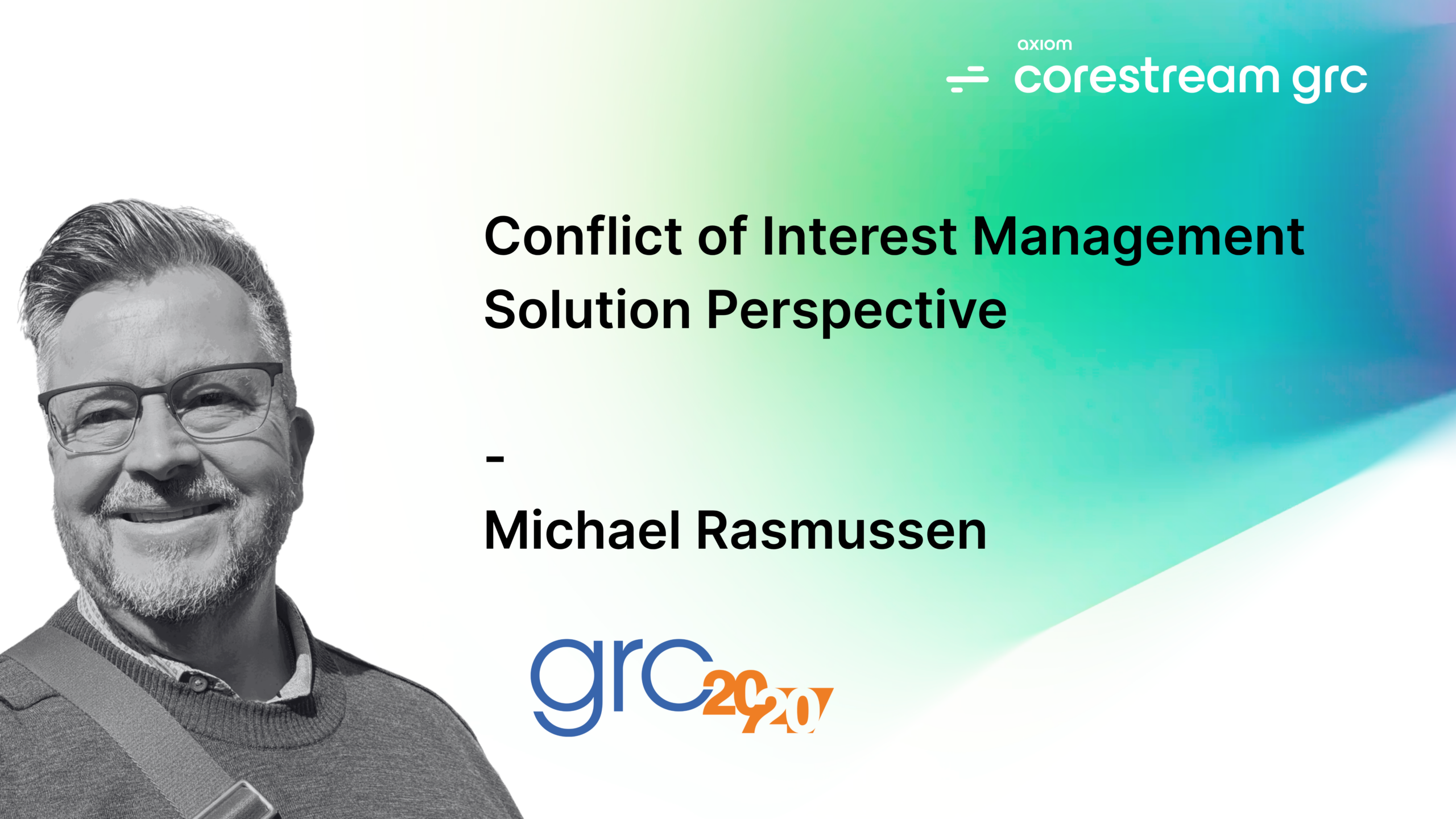
To put that belief to the test, we invited trusted GRC industry analyst Michael Rasmussen to independently evaluate the CoreStream Conflict of Interest Management solution. Michael reviewed a full product demonstration and spoke directly with CoreStream GRC’s COI users to understand how the solution performs in real-world environments, not just in theory.
The result is an impartial, analyst‑driven assessment that challenges conventional COI tools and highlights what organizations should expect from a modern, value‑driven GRC solution.
Below is a short preview of Michael’s analysis and key findings:
Enabling COI Governance Across the Lifecycle
CoreStream GRC is a solution that GRC 20/20 has researched, evaluated, and reviewed with organizations using it to modernize conflict of interest management in complex, regulated, and high-accountability environments. It is an agile, no-code GRC platform that supports a broad range of governance, risk management, and compliance use cases while proving particularly effective for staff declarations, conflicts of interest, gifts and hospitality, and related ethics and compliance workflows. CoreStream GRC delivers a flexible information architecture, intuitive user experience, and strong configurability that allow organizations to embed conflict processes into the way the business actually works.
CoreStream GRC provides organizations with out-of-the-box capabilities to support staff declarations, conflicts of interest, and connected compliance workflows, while also allowing those capabilities to be tailored to unique policies, decision structures, approval requirements, and regulatory obligations. GRC 20/20’s evaluation finds that CoreStream GRC delivers a practical, business-integrated approach that moves beyond annual forms and static registers into a structured lifecycle of disclosure, review, escalation, mitigation, attestation, and reporting.
What stands out in CoreStream GRC’s use for conflict of interest management is that it is not positioned as merely a digital questionnaire or annual attestation tool. Organizations are using it to operationalize a fuller governance model. Across deployments, the pattern is consistent: CoreStream GRC is being used not simply to collect disclosures, but to structure accountability around them.
GRC 20/20’s evaluation, research, and interactions with CoreStream GRC clients have determined the following:
Before CoreStream GRC.
Clients typically arrived from manual, email-driven, spreadsheet-based, or legacy-system approaches that made conflict of interest management cumbersome, inconsistent, and difficult to govern. Some had no central log of disclosures and no meaningful reporting capability. Others had older customized systems that were increasingly expensive to maintain and difficult to modernize. This left organizations with weak visibility, limited reporting, inconsistent follow-through, and excessive reliance on individual memory and judgment. One CoreStream GRC client stated they had hundreds of hours of time being spent on manual work to try and keep up with their COI requirements.
“When the culture signals that speed matters more than transparency, silence follows.
That leaves the organization exposed not simply because conflicts exist, but because the operating model makes it too easy for them to remain unmanaged.”
Why CoreStream GRC.
Organizations select CoreStream GRC for its configurability, ease of use, integrated architecture, and ability to align with the real operating model of conflict management. Clients value the platform’s ability to support tailored workflows, decision routing, review stages, mitigation plans, and reporting without requiring brittle, one-off customization. In some sectors, specific integration capabilities such as Open Payments are decisive. In addition to being able to connect/integrate with other GRC use cases like gifts and hospitality within CoreStream GRC’s platform.
How CoreStream GRC is used.
CoreStream GRC is being used to support onboarding declarations, annual and periodic attestations, ad hoc conflict disclosures, gifts and hospitality declarations, management review, compliance review, mitigation assignment, employee acknowledgment, and enterprise reporting. In more advanced use cases, it supports threshold-based logic, multi level routing, mitigation plan libraries, quarterly reviews, and integration with external data.
Where CoreStream GRC has excelled. Clients consistently highlight the platform’s flexibility, intuitive interface, workflow design, and reporting visibility. They also point to the value of CoreStream GRC’s implementation guidance, centralized visibility, automated notifications, and strong support culture. In conflict of interest management, where adoption and follow-through matter as much as feature depth, that combination is important.
Overall, CoreStream GRC enables organizations to move conflict of interest management out of scattered forms, inboxes, and static registers and into a governed, auditable, and repeatable operating model. It supports transparency without creating unnecessary friction and allows organizations to tailor the process to different risk levels, decision types, and stakeholder groups.
CoreStream GRC is particularly compelling where organizations need a single, connected environment for conflict of interest management rather than another standalone compliance utility. That includes organizations wanting to connect staff declarations to HR and onboarding, healthcare organizations reconciling internal disclosures with external payment transparency information, foundations managing sensitive governance issues, and regulated firms aligning conflicts, gifts and hospitality, compliance, and broader risk oversight in one system.
Want the full 18 page report? Download here.
Discover the references from the clients here.
FAQs on conflict of interest management
Conflict of Interest Management is the process organizations use to identify, disclose, review, mitigate, and monitor conflicts that could affect impartial decision-making. A strong COI program does more than collect annual declarations. It creates a clear, auditable process for managing conflicts across the full lifecycle.
Annual declarations can miss conflicts that arise throughout the year. A mature COI program treats conflict management as continuous, not episodic. That means supporting onboarding declarations, ad hoc disclosures, periodic attestations, management review, mitigation plans, employee acknowledgment, and reporting.
GRC 20/20 independently evaluated CoreStream GRC’s Conflict of Interest Management solution through a full product demonstration and direct conversations with CoreStream GRC COI users. The review focused on how the solution works in real-world environments, including disclosure workflows, review stages, escalation, mitigation, reporting, and user adoption.
An analyst-led review gives organizations an impartial view of whether a COI solution works in practice, not just in a demo. GRC 20/20’s perspective helps buyers understand what strong COI governance should look like and what to expect from a modern, value-driven GRC solution.