Organizations do not exist to manage risks. They exist to achieve objectives.
Yet too many risk programs are still built around the risk register. Teams spend countless hours identifying, scoring, and reviewing risks, only to be left with a list of red, amber, and green ratings that offer little insight into what leaders actually need to know.
For example:
- Can we achieve our strategic objectives?
- Can our critical operations withstand disruption?
- Are our controls protecting what matters most?
These are the questions boards and executives actually care about.So how do we get the answers?
The reality is simple: risks don’t exist in isolation. They exist in the context of business objectives. When organizations focus on risks without understanding their impact on outcomes, they risk losing sight of the bigger picture.
“The conversation has shifted from identifying risks to navigating uncertainty. Organizations don’t need another static list of risks. They need clarity on the outcomes they must deliver, the objectives that matter most, and the capabilities required to protect them when disruption occurs. They need confidence that they are doing what they say they are, and meeting the expectations and obligations set by all stakeholders.”
Emma Price, Partner, BRAVE
It’s time for a smarter approach.
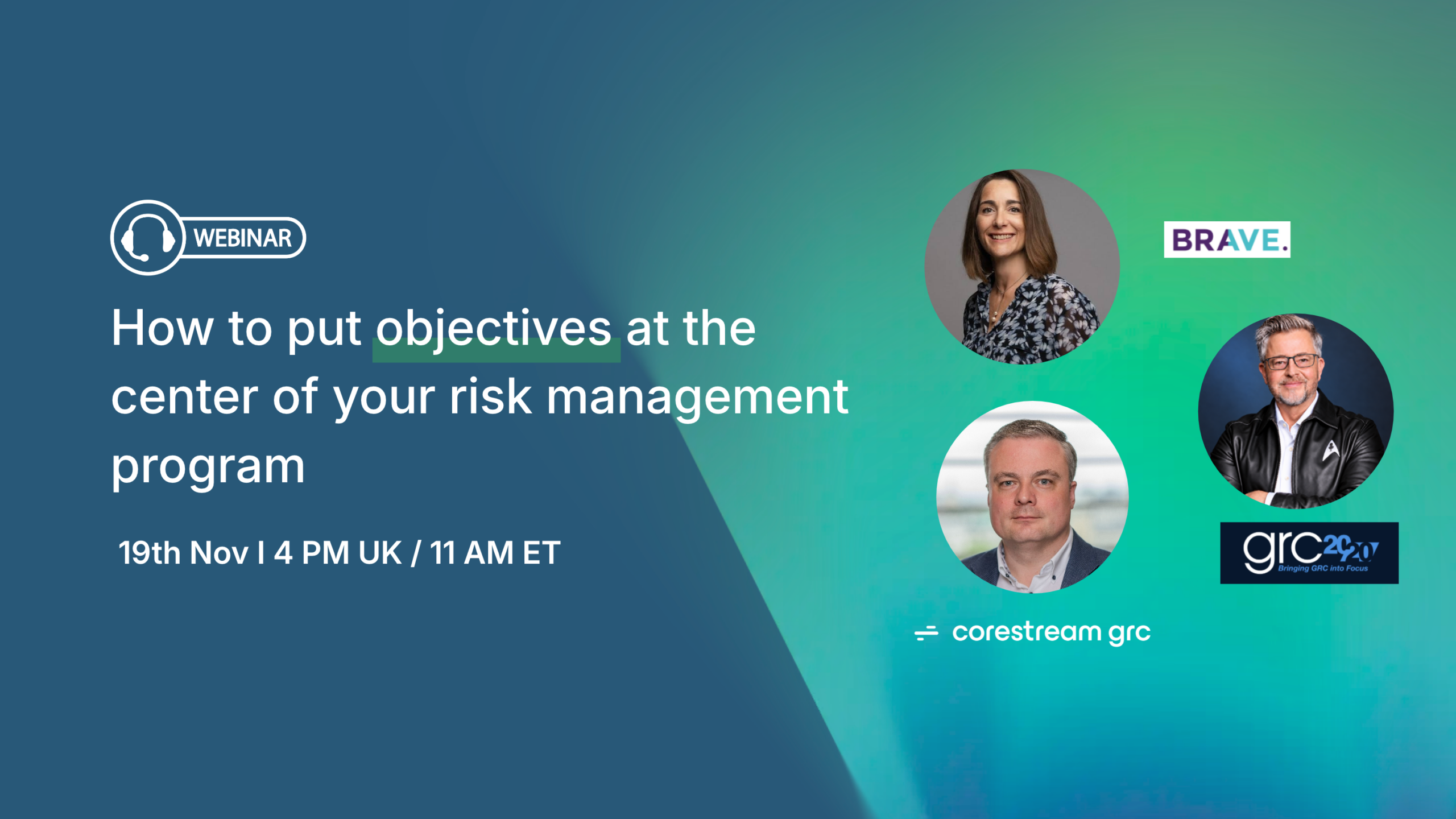
Which is why, Michael Rasmussen, Emma Price and Paul Cadwallader are coming together for an insightful discussion on how organizations can evolve from risk-centric to objective-centric risk management.
Date: 19th November 2026
Time: 4 PM UK / 11 AM ET
Why objective-centric risk management is the way forward
Many organizations have attempted to connect objectives to risks. But simply attaching a business objective to a risk register doesn’t fundamentally change how risk is managed.
Objective-centric risk management takes a different approach. Rather than measuring success by the number of risks identified, it focuses on whether the organization is positioned to achieve its strategic and operational goals.
This shift transforms risk management from a compliance exercise into a strategic business capability. It gives leaders greater visibility into the factors influencing performance, resilience, and decision-making, helping them focus resources where they will have the greatest business impact.
What is Objectives@Risk?
This is why CoreStream GRC and BRAVE created Objectives@Risk, to help organizations align risk management with business outcomes.
The framework connects objectives to the risks, controls, obligations, performance indicators, and assurance activities that influence their success, creating a clear picture of where confidence is strong and where action may be needed.
At its core, Objectives@Risk helps organizations answer a critical business question: “How confident are we in achieving our objectives, and what decisions and actions will increase that confidence?”
By combining BRAVE’s objective-centric methodology with CoreStream GRC’s flexible and intutive technology, organizations can move beyond standalone risk ratings and gain a more complete view of performance, resilience, and risk across the enterprise.
Because organizations don’t succeed by managing risks. They succeed by achieving their objectives:
“Value-Based GRC is about driving organizational success through risk taking underpinned by the right risk, compliance, control, assurance, and resilience data and activities.
This partnership reflects that philosophy perfectly. BRAVE starts with what the organization is trying to achieve, and CoreStream GRC helps operationalize that thinking through connected data, workflows, reporting, and decision support. The result is a more practical, integrated approach to GRC that helps leaders create and protect value.”
Paul Cadwallader, GRC Strategy Director, CoreStream GRC

What you’ll learn about objective-centric risk management
During the session, you’ll discover how to:
- Establish a clear line of sight from business objectives to outcomes, dependencies, risks, obligations, controls, and assurance activities
- Distinguish between acceptable risk and unacceptable exposure to support better business decisions
- Connect performance indicators, changing risk exposure, control effectiveness, and assurance data to identify where action is needed most
- Apply the Objectives@Risk framework to align methodology, business judgment, and technology
- Take practical first steps toward building a risk management program centered on objectives and business outcomes
You’ll also see a real-world case study demonstrating how performance indicators, changing risk exposure, control effectiveness, and assurance can be connected to identify where leadership attention and resources are needed most.
“I am a big objective fan of this solution. It’s like peanut butter and chocolate. They’re simply better together.”
Michael Rasmussen, GRC pundit
Meet the speakers
Michael Rasmussen
Pundit and Founder, GRC 20/20

Michael takes a research and advisory perspective, spanning objective-led GRC, risk and resilience, information architecture, AI governance, and the GRC technology market. Founder of GRC 20/20 Research and host of Risk Is Our Business and Hitchhiker’s Guide to the GRC Technology Galaxy.
Emma Price
Pioneer, BRAVE

Emma is a former Big 4 Partner and NED with 25+ years’ experience supporting boards, audit and risk committees, and executive teams across complex, fast-changing environments. Her background spans strategic risk, enterprise risk management (ERM), resilience, governance, internal controls, assurance and transformation, with leadership roles across EMEA, Australia and the United States. She has built and scaled high-performing risk practices, shaping pragmatic and innovative risk strategies that balance value protection with value creation Emma is recognized for her leadership in technology-enabled risk management and alternative risk delivery models.
Paul Cadwallader
GRC Strategy Director, CoreStream GRC

Paul is responsible for driving the strategic growth of the business and helping both new and existing clients achieve their desired outcomes using the CoreStream GRC platform. With over 25 years of experience in the governance, risk and compliance space, Paul leverages his background as a former Deloitte Partner to assist organizations in defining their requirements across governance, risk, controls, compliance, and assurance. At CoreStream GRC, Paul focuses on helping clients harness the power of the platform’s integrated and flexible capabilities to meet their needs and achieve their goals.
Reserve your place
Join us to discover how objective-centric risk management can help your organization strengthen decision-making, improve resilience, and increase confidence in achieving what matters most.
Register today and learn how to put objectives, not risk registers, at the center of your risk management program.
Frequently asked questions about objective-centric risk management
Objective-centric risk management is an approach that places business objectives at the center of risk decision-making. Rather than managing risks in isolation, organizations assess how risks, controls, dependencies, obligations, and assurance activities impact their ability to achieve strategic and operational goals. This helps leaders make better-informed decisions and focus resources where they will have the greatest business impact.
This webinar is designed for Chief Risk Officers (CROs), Risk Managers, Compliance Leaders, Internal Auditors, Business Continuity Professionals, Governance Professionals, and senior executives responsible for strategy, performance, and resilience. It is particularly valuable for organizations looking to align risk management activities with business objectives and outcomes.
Traditional risk management often focuses on maintaining risk registers and tracking individual risks. Objective-centric risk management goes further by connecting risks directly to business objectives, enabling organizations to understand whether their goals are achievable, where exposure is unacceptable, and which actions will most effectively improve confidence in success.
Attendees will learn how to establish clear links between objectives, outcomes, dependencies, risks, controls, and assurance activities. The webinar will also explore the Objectives@Risk™ framework, demonstrate a practical case study, and provide actionable steps for evolving from a risk-centric to an objective-centric risk management program.