Lila Landis on building compliance across 100 countries, winning stakeholder support through influence rather than authority, and ensuring GRC helps organizations move faster rather than slowing them down.
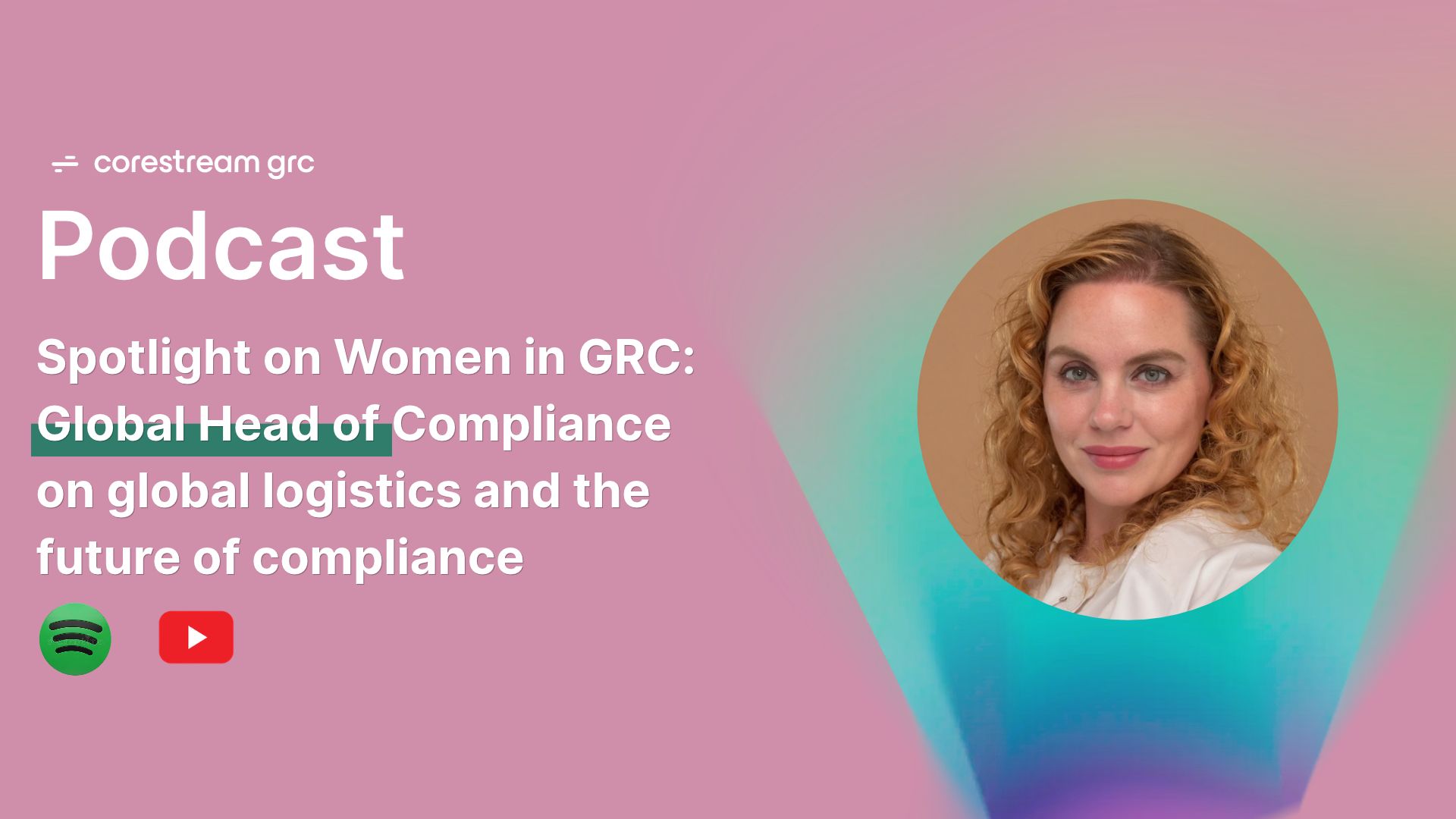
In the latest Spotlight on Women in GRC podcast, host Lucy Montague speaks with Lila Landis, Global Head of Compliance at JAS Worldwide, a global freight forwarder, customs broker and logistics provider operating in approximately 100 countries.
Lila Landis’ career spans international trade, customs, export controls, sanctions, ethics and compliance. Along the way, she has built and transformed compliance programs, supported humanitarian aid shipments, helped organizations navigate global regulatory challenges and become a leading voice on how compliance can create business value rather than simply manage risk.
In this Spotlight on Women in GRC podcast episode, Lila shares:
- How to create a consistent compliance framework across 100 countries without creating local silos
- What every new Head of Compliance should prioritize in their first 100 days
- Why trust and stakeholder relationships matter more than policies alone
- How data and real business examples help build a stronger compliance culture
- Why compliance should be involved before decisions are made, not after
- How AI can remove administrative burden while preserving critical thinking
Global operations, local realities: How do you build compliance across 100 countries?
Many compliance leaders struggle to balance consistency with local regulatory requirements. For Lila, that challenge is amplified every day.
Jazz Worldwide operates in approximately 100 countries, creating a level of regulatory complexity most organizations never experience. Yet despite that complexity, Lila believes you have to accept that: “You can’t be an expert in every jurisdiction. Even within one jurisdiction, you can’t be an expert across all of the regulatory areas.”
Instead, successful global compliance depends on building the right network of expertise, understanding where to find reliable information and knowing when local specialists need to be involved.
That philosophy has become increasingly important as organizations expand internationally. Thomson Reuters Regulatory Intelligence report monitored regulatory events and found the equivalent to an average of 234 daily alerts across 1374 regulators in 190 countries.
Lila is currently addressing this challenge by creating a stronger global foundation for compliance:
“I just launched a global compliance manual that brings together a number of our compliance policies and then also adds additional detail… so there’s a place where we’re giving specific examples of what for example, does a conflict of interest look like for us.”
Lila Landis, Global Head of Compliance, JAS Worldwide
The approach is striking because it challenges a common compliance assumption, many organizations either centralize or localize everything.
The issue is centralized programs often ignore local realities. Localized programs frequently create fragmented processes, duplicate effort and inconsistent reporting. The stronger model is a global framework supported by local expertise. As Lila explains:
“We have kind of a global foundation that then we can go in and add some of those regional and local nuances to.”
Lila Landis, Global Head of Compliance, JAS Worldwide
The first 100 days as Head of Compliance: Start with training, risk and culture
When resources are limited, many new compliance leaders focus on technology, governance committees or major transformation initiatives. Lila starts somewhere simpler, training.
“I think training is a big one and training doesn’t have to cost a lot.”
Lila Landis, Global Head of Compliance, JAS Worldwide
Whether through lunch-and-learns, Teams sessions or formal learning platforms, she believes training creates one of the quickest and most cost-effective compliance quick wins available. Particularly with the help of AI. Lila talks about how AI can surface information faster. AI can accelerate administrative work, however, she believes human judgment remains essential. So Lila may use AI to draft a framework for the training but will draft the custom content herself.
Training and AI automation is an effective visible sign to the organization of the change to come from the new compliance leader, however, the real priority is understanding risk.
“I’m not going to come in and give you a template that I’ve used at some other organization because each organization is unique.”
Lila Landis, Global Head of Compliance, JAS Worldwide
The goal is not simply identifying gaps. It is understanding how the organization actually operates, and that means going beyond policy reviews.
“There’s a big difference between having a good compliance program on paper and having one that is actually being used in practice.”
Lila Landis, Global Head of Compliance, JAS Worldwide
This reflects a wider challenge facing compliance teams.
Research consistently finds that organizations struggle to move from documented compliance programs to genuine employee engagement and adoption. Training completion rates are easy to measure. Cultural adoption is much harder. According to eLearning Industry: “Only 10% of employees report that compliance training actually impacts their daily work practices.”
Which is why Lila spends as much time talking to people as reviewing documents and compliance metrics.

Stop selling compliance, and start telling business stories.
One of the most powerful lessons from the conversation is that compliance success rarely comes from authority, but influence. Lila actively seeks out influential individuals across regions and departments.
“You need to identify who those people are so that you can get them on board and they can push it down.”
Lila Landis, Global Head of Compliance, JAS Worldwide
Equally important is identifying those who may resist compliance initiatives. A standout example came from a previous organization where a senior leader questioned the need for safety footwear in warehouses. Rather than arguing, Lila dug into the organizational data: “70% of the injuries we’ve had have been injuries to the foot. I think we need some safety shoes.”
The reality is that employees rarely change behavior because a policy exists, they change behavior when they understand why something matters. As Lila puts it, compliance culture: “comes down to a lot of building trust and rapport.”
Lila illustrates this with another example from her company: the IT team needed equipment shipped to the company’s Moscow office, without consulting compliance, they purchased the router in Texas and shipped it internationally:
“That router was seized by Russian customs and never seen again.”
Lila Landis, Global Head of Compliance, JAS Worldwide
The story became a powerful lesson across the organization, because people saw a real-world consequence, money and time lost. Lila frequently uses examples like these to demonstrate why compliance matters.
She also tailors her approach depending on who she is speaking to:
“I really think a lot about my audience when I am trying to be convincing.”
Lila Landis, Global Head of Compliance, JAS Worldwide
The best compliance leaders are often excellent communicators, they understand that data may persuade one audience while business impact, operational efficiency or customer trust may resonate with another.
For compliance teams struggling to gain support, this is a useful challenge: If stakeholders are not engaging with compliance, the issue may not be the message. It may be the way the message is being delivered. The Project Management Institute warns that “56% of the money at risk on any given project is due to ineffective communication.” Which Lila’s IT story illustrates perfectly.
The next era of GRC: From organizational watchdog to strategic advisor
A strong theme throughout the discussion was Lila’s belief that compliance needs a bigger role in organizational decision-making. 77% of respondents in global surveys report that disconnects in the compliance ecosystem negatively impact areas that drive business growth PwC.
“We have to continue the trend that I already see, which is about integrating compliance in the organization in a way where we’re not an afterthought.”
Lila Landis, Global Head of Compliance, JAS Worldwide
That shift is already happening across many organizations, compliance leaders are increasingly involved in strategic initiatives, acquisitions, digital transformation and AI governance.
Lila highlights mergers and acquisitions as a particularly important opportunity:
“Getting involved with your M&A folks from the outset… that is a key function in the organization that you need to build a relationship with.”
Lila Landis, Global Head of Compliance, JAS Worldwide
Too often compliance is asked to assess risk after decisions have already been made, and at that point, options are limited. So the sooner compliance can be implemented the better, as “you never want to bring a problem with no solution.”
Organizations increasingly need to implement GRC advisors who balance risk with opportunity, not functions that simply highlight potential issues from the very start.
Non GRC folks assume compliance professionals mainly work on policies, controls and spreadsheets. Lila’s experience demonstrates the dynamic variety a role in risk and compliance can bring, as she has supported humanitarian aid shipments, disaster relief initiatives and complex cross-border trade challenges.
“Compliance often gets a bad rap for being treated like something that is purely analytical and that all we do all day are look at spreadsheets.”
Lila Landis, Global Head of Compliance, JAS Worldwide
Instead, she describes a profession built on communication, influence, learning and creativity.
“It really does involve a lot of people skills, a lot of creativity. There’s a lot of psychology and political awareness within the organization that goes into making a compliance program successful.”
Lila Landis, Global Head of Compliance, JAS Worldwide
For anyone considering a career in GRC, modern compliance is as much about people as it is about regulations.
Conclusion: Modern compliance is built on influence, not enforcement
Lila’s experience offers a compelling picture of where compliance is heading, the future is stronger stakeholder relationships, earlier involvement in decision-making and smarter use of technology.
Whether building compliance programs across 100 countries, onboarding new acquisitions or introducing AI into day-to-day operations, the principles remain remarkably consistent:
- Build trust.
- Understand your audience.
- Use data and real-world examples.
- Focus on business outcomes.
- And never become an afterthought.
As Lila puts it:
“Being strategic is one of the best skills that you can demonstrate to leadership.”
Lila Landis, Global Head of Compliance, JAS Worldwide
The compliance leaders who thrive over the next decade will be the ones helping the business move forward safely, responsibly and with confidence.
About Lila Landis
Lila Landis is a global compliance leader with extensive experience across international trade, logistics, ethics and regulatory compliance. As Global Head of Compliance at Jazz Worldwide, she is responsible for strengthening and scaling compliance programs across a business operating in approximately 100 countries. Her expertise spans customs compliance, export controls, sanctions, anti-corruption, ethics and corporate governance, helping organizations navigate complex global regulatory environments while supporting business growth.
About Spotlight on Women in GRC
Spotlight on Women in GRC is a podcast series created to continue the conversations sparked by the Women in GRC Awards and carry those insights beyond the event. Supported by CoreStream GRC and hosted by Lucy Montague, the series shines a light on the women shaping governance, risk and compliance across the world.
Condensed transcript of the Lila Landis podcast episode
Lucy Montague:
Welcome to Spotlight on Women in GRC, a podcast series created to continue the conversations sparked by the Women in GRC Awards. Supported by CoreStream GRC, the series shines a light on the women shaping governance, risk and compliance. Today I’m joined by Lila Landis, Global Head of Compliance at JAS Worldwide. Lila, welcome.
Lila Landis:
Thank you so much for having me.
Lucy Montague:
Can you start by introducing yourself and telling us a little about your role?
Lila Landis:
I’m the Global Head of Compliance for Jazz Worldwide, a global freight forwarder, customs broker and logistics provider operating in around 100 countries. My role covers a broad range of compliance responsibilities including customs compliance, export controls, sanctions, anti-money laundering, anti-bribery and corruption, antitrust, ethics and corporate governance. What I enjoy most is building and transforming compliance programs, identifying gaps and creating solutions that fit the organization’s unique risk profile.

Building compliance across 100 countries
Lucy Montague:
What are some of the biggest challenges of leading compliance across so many different regulatory environments?
Lila Landis:
You can’t be an expert in every jurisdiction. Even within one jurisdiction, you can’t be an expert across every regulatory area. The key skill is knowing where to find the information, how to interpret it and when to bring in additional expertise.
I’m fortunate to work closely with a strong legal team and regional counsel. We collaborate on issues, compare interpretations and engage local experts when needed. Compliance is absolutely a team sport.
Lucy Montague:
What are your priorities right now?
Lila Landis:
One area we’re focusing on is finding the right balance between global consistency and local requirements. We recently launched a global compliance manual that brings together our policies and adds practical examples relevant to our business.
I don’t have a compliance person in every country where we operate. Nobody does. So you need a strong global foundation that can then be adapted with regional and local nuances.
We’re also localizing training to make it more relevant to our industry. People understand compliance much better when they can see how it applies to their day-to-day work.

The first 100 days as a compliance leader
Lucy Montague:
When resources are limited, where should a new Head of Compliance focus their first 100 days?
Lila Landis:
Training is one of the biggest opportunities because it doesn’t have to be expensive. You can run lunch-and-learn sessions, Teams meetings or short workshops that focus on topics like anti-bribery, corruption or antitrust.
The second priority is a thorough risk assessment.
I’m not going to come into an organization and apply a template I’ve used somewhere else because every organization is unique. They have different risks, different cultures and different levels of maturity.
I typically assess risk across three areas: people, processes and technology. Once you understand your risk profile, you can focus your time and resources where they’ll have the greatest impact.
Lucy Montague:
Do you prefer reviewing documentation or interviewing stakeholders?
Lila Landis:
Both.
I always start with a desk assessment to understand what policies, procedures and training already exist. But then I talk to people.
You might have a great anti-bribery policy, but does anyone know it exists? Have they read it? Is the training relevant?
There’s a big difference between having a good compliance program on paper and having one that’s actually being used in practice.

Creating a culture of compliance
Lucy Montague:
How do you make compliance everyone’s responsibility rather than just the compliance team’s?
Lila Landis:
You need leadership support, but it goes beyond the CEO.
One of the first things I do is identify the influencers across different regions and functions. These are the people who can help drive adoption of policies and processes throughout the organization.
It’s equally important to identify people who might resist compliance initiatives and understand how to bring them on board.
I once worked with a COO who believed warehouses didn’t need safety shoes. Rather than arguing, I used company data to show that 70% of workplace injuries were foot injuries. Suddenly the conversation changed.
You can’t build a compliance culture by simply telling people to follow policies because you’re the compliance person. It comes down to building trust, credibility and relationships.

Using stories and data to win support
Lucy Montague:
Do real-world examples help create that engagement?
Lila Landis:
Absolutely.
I remember a situation where an IT team wanted to send a Cisco router from Texas to a company office in Moscow. Nobody checked with compliance first.
The router was seized by Russian customs and was never seen again.
That became a powerful lesson because it showed why compliance should be involved early. Sometimes examples like that resonate more effectively than any policy or training session.
I also think carefully about my audience. Some people are persuaded by data. Others are persuaded by practical impact or emotional arguments. The most effective compliance leaders understand which approach is needed in each situation.

Navigating challenges as a woman in leadership
Lucy Montague:
Have you experienced barriers or bias throughout your career?
Lila Landis:
Unfortunately, yes.
Early in my career, I applied for a leadership role after helping a team consistently achieve targets it had never previously reached. When I interviewed, I was told they felt the role should go to an older man.
It was disappointing, but it ultimately pushed me to seek opportunities elsewhere, which led me into trade compliance and helped shape the career I have today.
I’ve also been fortunate to work with fantastic leaders who actively supported my development. Sometimes the best thing you can do is recognize when an organization isn’t the right place for you and move on.

Why compliance is more interesting than people think
Lucy Montague:
What would you say to someone considering a career in compliance?
Lila Landis:
I’d tell them it’s far more interesting than people realize.
I’ve worked on humanitarian shipments to sanctioned countries, disaster relief efforts and incredibly complex global trade challenges.
Compliance gets a bad reputation because people assume it’s all spreadsheets and policies. In reality, it requires creativity, people skills, strategic thinking and problem solving.
You also never stop learning. Regulations change, industries evolve and global events constantly reshape the landscape. That’s what keeps it exciting.

Using AI without losing critical thinking
Lucy Montague:
Are you using AI in your work?
Lila Landis:
Absolutely.
I use AI for research, outlining documents, translations, finding information and summarizing longer content.
What I don’t do is use it to replace my own thinking.
I don’t like using AI to write emails or draft everything for me because I think you lose that muscle memory and critical thinking capability.
AI is fantastic for helping with administration and getting started, but people can become too reliant on it. You still need human judgment, particularly in compliance.

The future of compliance
Lucy Montague:
What will define the next era of compliance?
Lila Landis:
I think we need to continue moving toward a model where compliance is integrated into the business rather than treated as an afterthought.
Compliance shouldn’t be seen as law enforcement. It should have a seat at the table, helping organizations grow while managing risk appropriately.
One example is mergers and acquisitions. Compliance leaders should build relationships with M&A teams and get involved from the beginning, not after decisions have already been made.
Being strategic is one of the most valuable qualities compliance leaders can demonstrate. If you identify a risk, you should also present potential solutions.
You never want to bring a problem with no solution.

Career advice
Lucy Montague:
What’s the best piece of career advice you’ve ever received?
Lila Landis:
A former leader once told me: “Even if you don’t own the action, you own the results.”
I had been waiting for someone else to respond to an email before moving forward on a project. He reminded me that as a leader, you can’t always sit back and wait.
Sometimes you need to follow up, call people, schedule meetings and keep things moving.
That advice has stayed with me throughout my career because leadership isn’t just about managing tasks. It’s about owning outcomes.

Lucy Montague:
Lila, this has been a fantastic conversation. Thank you so much for joining us.
Lila Landis:
Thank you for having me. It’s been my pleasure.
Lucy Montague:
And thank you to everyone listening. We’ll see you next time on Spotlight on Women in GRC.
FAQs: Global compliance programs, culture, and AI
Build a global compliance program around a consistent framework supported by local expertise. A shared compliance manual gives employees a common foundation, while regional and local specialists help adapt it to jurisdiction-specific requirements. The approach described in this episode balances global consistency with local realities, rather than relying on either complete centralization or disconnected local programs.
The first 100 days should focus on understanding the organization’s risks, culture, and existing compliance practices. Speak with stakeholders, review how policies work in practice, and identify influential people who can support change. Practical training, including short sessions or lunch-and-learns, can deliver early progress while you build a program tailored to the business rather than importing a generic template.
A strong compliance culture depends on trust, relevant training, and a clear understanding of why compliance matters. Use real business examples to connect policies with everyday decisions, and talk to employees about how guidance is applied. Training completion alone does not show whether a program is working; the blog emphasizes the difference between documented policies and compliance that people actually practice.
Compliance teams can gain stakeholder buy-in by connecting their message to the audience’s priorities. Use organizational data, operational examples, and clear explanations of business impact to show why a change is needed. Building relationships with influential people across departments and regions helps compliance earn support through trust and influence, rather than relying on policies or authority alone.
Compliance creates business value when it helps teams understand risks and identify practical solutions before decisions are finalized. Early involvement in international operations, acquisitions, and other strategic initiatives gives the business more options than a review after commitments have been made. The episode positions compliance as a strategic advisor that balances risk with opportunity, not simply a function that highlights problems.
AI can support compliance teams by surfacing information faster, reducing administrative work, and helping draft training frameworks. In the episode, the approach is to use AI for an initial structure while keeping custom content and critical thinking with the compliance professional. The aim is to free up time for work requiring business context and human judgment, not to replace that judgment.