
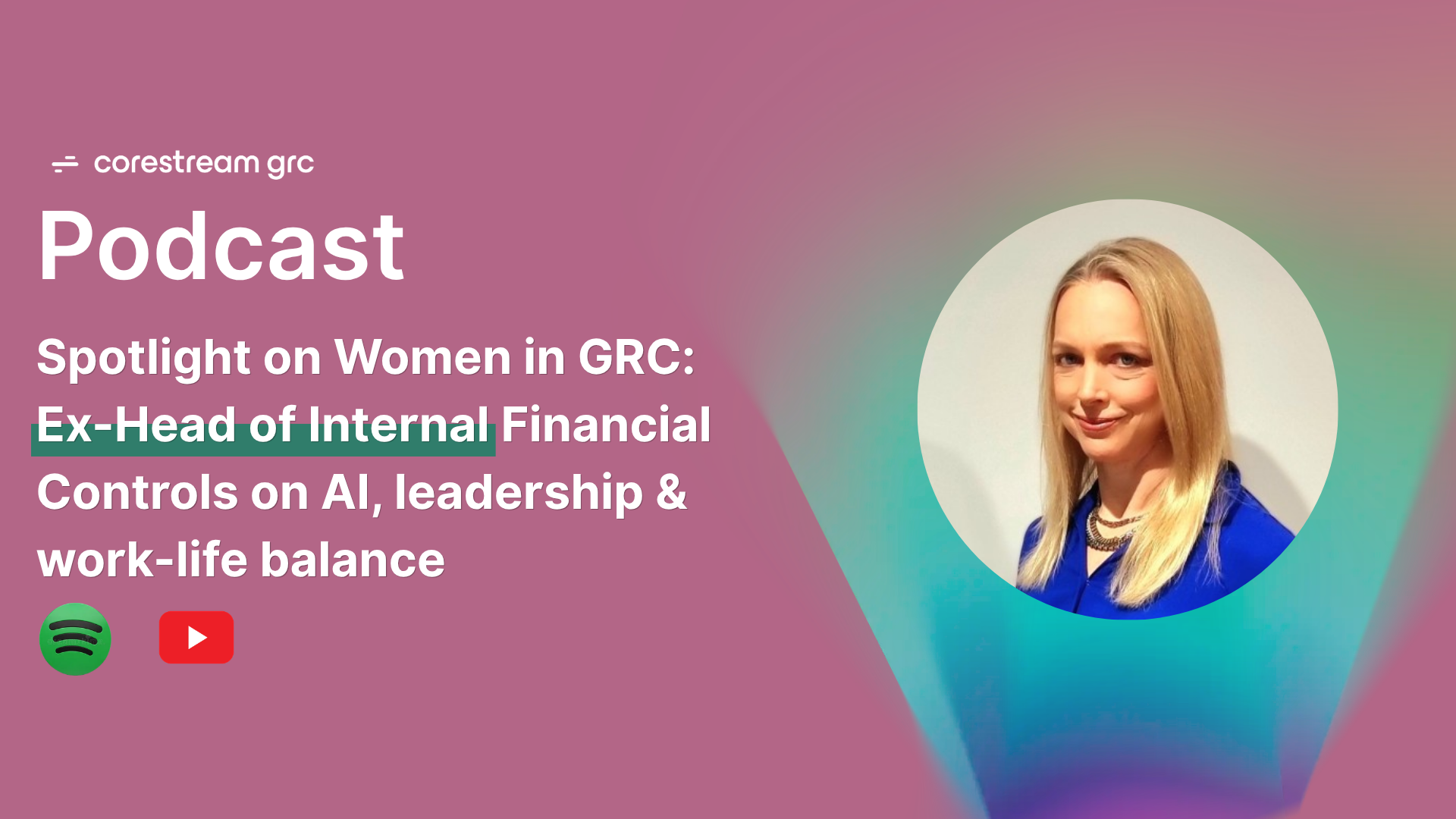
To countdown to the Women in GRC Awards on 2 July 2026, we are running a podcast series, “Spotlight on Women in GRC”. In this episode, CoreSream GRC’s Head of Marketing, Lucy Montague sits down with Nikki Absolom, Tax Technology and Transformation Lead at IVC Evidensia, former Head of Controls at Pets at Home, and an Independent Board Member and Chair of the Finance and Audit Committee at British Weight Lifting.
Nikki’s career has moved across Big 4 accountancy, telecommunications, automotive, banking, retail, veterinary services, finance transformation, and internal controls. That breadth has shaped a practical approach to governance, risk, and compliance:
- understand the detail,
- challenge inefficient processes,
- use technology to remove work that does not require human judgment.
The discussion explores:
- Why curiosity, cross-sector experience, and a willingness to challenge inefficient processes matter in GRC.
- Why integration and connected controls matter just as much as standalone AI use cases.
- How the UK Corporate Governance Code is changing the internal controls agenda.
- Why automation should create more space for human judgment, not remove it.
- How employers can support women’s progression without forcing them to sacrifice flexibility.
- How Pets at Home used AI within CoreStream GRC to reduce the time required to draft test plans by around 65%.
How did Nikki Absolom build a career across risk, controls, and transformation?
Nikki’s route into GRC was not linear. She started her career in the Big 4 before moving into an external reporting role at Vodafone. Shortly after she joined, a major new controls challenge emerged for international businesses listed in the US: the introduction of the Sarbanes-Oxley Act.
“Something that nobody had heard of came along called Sarbanes-Oxley. These were the proper early days of SOX, when it was just being rolled out in the US. When we found out that foreign private issuers needed to comply, a team was set up and I was the 2nd person recruited onto the SOX team at Vodafone.”
Nikki Absolom, Tax Technology and Transformation Lead at IVC Evidensia and former Head of Controls at Pets at Home
The Sarbanes-Oxley Act of 2002 commonly known as SOX, introduced stricter requirements for public companies around financial reporting, corporate accountability, and internal controls. Under Section 404, relevant companies must assess and report on the effectiveness of their internal controls over financial reporting.
Nikki spent around 5 years helping Vodafone roll out SOX requirements across the business.
“That was quite a strong introduction to risk and control. We had 28 operating companies asking us questions about what they needed to do, so we had to find out the answers.”
Nikki Absolom, Tax Technology and Transformation Lead at IVC Evidensia and former Head of Controls at Pets at Home
This experience enabled Nikki to really understand the detail, and translate a new regulatory requirement into processes that different parts of the organization could apply.
Her career later expanded into finance transformation and systems implementation. After leaving Vodafone, she worked across several organizations, including BMW and Nationwide, before joining Vets for Pets, part of the Pets at Home group.
That role brought her back into internal controls at a time when the revised UK Corporate Governance Code was beginning to reshape the conversation. The Financial Reporting Council’s UK Corporate Governance Code 2024 strengthens the focus on material internal controls. Under Provision 29, boards must monitor the company’s risk management and internal control framework, review its effectiveness at least annually, and provide a declaration in the annual report.
Provision 29 applies to financial years beginning on or after 1 January 2026. The FRC’s Provision 29 mythbuster makes clear that the review should cover material financial, operational, reporting, and compliance controls.
As GRC analyst Michael Rasmussen puts it:
“Provision 29 is about pulling risk and controls from the boiler room to the bridge.”
For Nikki, helping Pets at Home build a stronger controls framework created a new challenge while allowing her to retain the flexibility she needed at that stage of her life.
“It was a way of staying and keeping my work-life balance, but also giving myself a bit more of a challenge and using some of the intellectual property that I developed previously at Vodafone.”
Nikki Absolom, Tax Technology and Transformation Lead at IVC Evidensia and former Head of Controls at Pets at Home
Why can moving across sectors make GRC professionals stronger?
Telecommunications, automotive, banking, retail, and veterinary services operate in very different environments. But Nikki sees real value in moving between sectors.
“For me, changing industries is a way of keeping it interesting. You might still be doing GRC, which is relatively generic, if you like, but applying it in different ways in a different industry, that’s where you get a challenge and excitement.”
Nikki Absolom, Tax Technology and Transformation Lead at IVC Evidensia and former Head of Controls at Pets at Home
The core principles may remain consistent, but the context changes. Different businesses have different operating models, cultures, pressures, customers, systems, and risk profiles. Moving between industries gives GRC professionals a chance to see how the same principles work in practice under different conditions, regulations and trends.
For professionals starting their careers, Nikki’s advice is clear:
“I would always say try everything.”
Nikki Absolom, Tax Technology and Transformation Lead at IVC Evidensia and former Head of Controls at Pets at Home
That breadth can make risk and compliance professionals more adaptable. It can also prevent a team from becoming too attached to one way of working. An approach that made sense 5 years ago may no longer be the most efficient option.
What does practical AI transformation look like in GRC?
For Nikki Absolom, practical AI transformation started with a simple process efficiency focus. During the COVID-19 pandemic, teams became more comfortable recording discussions through Microsoft Teams. That made it easier to capture conversations about business processes. Once transcripts were available, the next step was obvious: use AI to turn those discussions into draft process documentation. Such a simple small step, but this then began the developed AI pathway for Pets at Home and their team.
From there, Pets at Home began looking at the repetitive work taking place within its controls environment and asking where AI could make a measurable difference.
“We started looking with CoreStream GRC at which bits were repetitive or not value-added. That was things like writing test plans, because writing test plans is really tedious.”
Nikki Absolom, Tax Technology and Transformation Lead at IVC Evidensia and former Head of Controls at Pets at Home
Rather than asking teams to leave their existing workflow and use a disconnected tool, Pets at Home integrated its own large language model into CoreStream GRC. When a control had already been documented, users could generate a draft test plan based on the control description.
“Where we had a control written, we could just press a button and it would draft a test plan based on the control description.”
Nikki Absolom, Tax Technology and Transformation Lead at IVC Evidensia and former Head of Controls at Pets at Home
According to Nikki, this reduced the time required to write test plans by around 65%. That is the kind of result that matters. It did not remove the need for review. It removed part of the manual burden, allowing the team to focus its time where it added more value.
The same approach was applied to risk management. AI helped teams improve risk descriptions, draft potential causes, and suggest key risk indicators. The goal was not to replace professional judgment. It was to give users a stronger starting point.
“Rather than diving out into a separate system, we could just click on it within CoreStream GRC, and it would do the heavy lifting for us.”
Nikki Absolom, Tax Technology and Transformation Lead at IVC Evidensia and former Head of Controls at Pets at Home
Why does integration matter just as much as AI?
The AI use cases at Pets at Home are a strong example of practical innovation. But Nikki’s approach to transformation is broader than AI.
Several years ago, Pets at Home integrated its HR system with CoreStream GRC’s Policy Management solution. The aim was simple: make sure new starters received the right policies from day 1 without relying on someone to assign each document manually.
That matters in a retail environment. When an organization has thousands of colleagues working across stores and support functions, policy communication cannot depend on inbox reminders and manual follow-up.
Pets at Home used CoreStream GRC to issue policy communications and track read receipts. According to Nikki, around 10,000 colleagues received relevant policies and the organization achieved an 80% policy read rate for certain communications.
“We could send emails out to all the colleagues to say, ‘You need to read this policy.’ When they had read it, they needed to tick the box to say that they had read it. We had about 10,000 colleagues and we were getting around an 80% completion rate, which is impressive in retail, where a lot of colleagues are on the shop floor.”
Nikki Absolom, Tax Technology and Transformation Lead at IVC Evidensia and former Head of Controls at Pets at Home
The result was not simply a higher number on a dashboard. It gave the organization stronger evidence that relevant colleagues had received and acknowledged important policies.
“As automation increases, human judgment and ethical decision-making start to become much more important as well. The AI, automation, and integration will be doing the heavy lifting.”
Nikki Absolom, Tax Technology and Transformation Lead at IVC Evidensia and former Head of Controls at Pets at Home
This is consistent with the direction of authoritative AI risk guidance. The NIST AI Risk Management Framework is designed to help organizations manage AI risks and promote trustworthy and responsible use. Its supporting AI RMF Playbook says organizations should define roles and responsibilities for human-AI configurations and oversight. The framework also recommends that processes for human oversight are defined, assessed, and documented.
The UK government’s AI Playbook makes a similar point. AI systems should be trustworthy, accountable, transparent, robust, secure, and resilient. Monitoring should continue after deployment, not stop once a system goes live.
The strongest AI-powered GRC approach is therefore not a black box. It should help people work faster while keeping responsibility, evidence, and review visible.
For Nikki, the aim is straightforward:
“Freeing up human resource to do more of the judgmental things and the evaluation that we need to maintain our human in the loop for, rather than leaving it all to AI to run away and cause chaos.”
Nikki Absolom, Tax Technology and Transformation Lead at IVC Evidensia and former Head of Controls at Pets at Home
What will the next 5 years of GRC transformation look like?
Nikki sees significant potential for automation to reshape how teams manage governance, risk, and compliance.
“I think there is an opportunity for a massive shift, because there is still so much that is manual.”
Nikki Absolom, Tax Technology and Transformation Lead at IVC Evidensia and former Head of Controls at Pets at Home
Several areas stand out:
- Continuous monitoring becoming a normal part of risk and control management.
- Better data quality supporting clearer decisions.
- Controls embedded into business processes rather than treated as an additional layer.
- More automated reporting.
- Better integration between teams and systems.
- Less repetitive work for risk, compliance, and audit teams.
- This direction is already reflected in how Gartner describes the role of modern GRC technology:
“GRC tools empower leaders to automate, manage and report on enterprise-level risks comprehensively.”
The direction of travel is already visible in the UK internal controls agenda. Provision 29 requires boards to monitor and review the effectiveness of material controls. The FRC has emphasized that companies may rely on information collected internally to support reporting and the board’s declaration. That creates a practical question for organizations: is the evidence current, connected, and reliable enough to support meaningful oversight?
A spreadsheet updated once a quarter may document a process. It does not necessarily give leaders the visibility they need to understand whether a control is operating effectively today.
Nikki’s view is that stronger GRC tools should help organizations move toward a more connected enterprise risk management approach.
“GRC is still quite siloed. Technology and automation can only help integrate GRC across businesses and make the enterprise risk management piece a whole lot easier.”
Nikki Absolom, Tax Technology and Transformation Lead at IVC Evidensia and former Head of Controls at Pets at Home
That is where the value becomes clearer, it is to improve how the organization sees, understands, and responds to risk across different parts of the organization.
“That is when you start to see the value from GRC, when you start to see the value across different parts of the business.”
Nikki Absolom, Tax Technology and Transformation Lead at IVC Evidensia and former Head of Controls at Pets at Home
How can organizations help women progress without sacrificing flexibility?
The conversation also raises a harder question: why does the representation of women fall as careers progress?
The McKinsey and LeanIn.Org Women in the Workplace 2025 report found that women account for 49% of entry-level roles but only 29% of C-suite positions. The report also found that women remain underrepresented at every level of the corporate pipeline.
There is no single explanation for that gap. Structural barriers, unequal opportunities, caregiving responsibilities, workplace culture, and personal choices can all play a role.
Nikki’s perspective is personal and deliberately honest. At certain stages of her career, stability and flexibility mattered more than pursuing the next title as quickly as possible.
“A lot of my friends would admit to staying in a role longer than they possibly should have because they wanted the stability. When you have the chaos of kids, family, sport, and everything going on, having stability in your work life helps you manage the chaos outside.”
Nikki Absolom, Tax Technology and Transformation Lead at IVC Evidensia and former Head of Controls at Pets at Home
That should not be mistaken for a lack of ambition. Progression does not need to follow one fixed path. The more useful question for employers is whether people can keep developing without being forced to choose between growth and a sustainable life outside work.
“How can we increase someone’s remit so that they are still getting some development and being stretched, but in more manageable ways?”
Nikki Absolom, Tax Technology and Transformation Lead at IVC Evidensia and former Head of Controls at Pets at Home
Flexible working can make a measurable difference. The CIPD’s Flexible and hybrid working practices in 2025 report found that 80% of employees said flexible working had a positive impact on their quality of life. The CIPD also reported that around 1.1 million employees had left a job in the previous year because of a lack of flexibility.
For Nikki, part-time and flexible working allowed her to remain in the profession while protecting what mattered outside work.
“Being able to work part-time at points in my career made a massive difference. It allowed me to stay in the game without compromising my life outside work.”
Nikki Absolom, Tax Technology and Transformation Lead at IVC Evidensia and former Head of Controls at Pets at Home
Director of Risk, Lauren, also spoke to this point in her episode: “You need to pick your bosses wisely, as well as picking the next role. And if somebody doesn’t have a good culture, then don’t go for that role. Go somewhere where you can have the flexibility.”
What advice does Nikki Absolom have for women starting a career in GRC?
Nikki’s advice is to get into the detail.
“Do not be afraid to get your hands dirty. Really get into the nitty gritty and understand processes at the root level.”
Nikki Absolom, Tax Technology and Transformation Lead at IVC Evidensia and former Head of Controls at Pets at Home
That detailed understanding matters because inefficient processes often continue for a simple reason: people are busy. They repeat the steps they have always followed because they do not have time to stop and reconsider them.
Strong GRC professionals create that space. They understand how the process works today, step back, identify what has changed, and ask whether there is a better way.
“People are busy on the hamster wheel. They never take a step back to think about how things have changed since they first started and what improvements they could make.”
Nikki Absolom, Tax Technology and Transformation Lead at IVC Evidensia and former Head of Controls at Pets at Home
The second part of Nikki’s advice is to stay curious. Governance, risk, and compliance gives professionals a rare opportunity to understand how different parts of an organization work and how risks flow across teams and processes.
“One of the best things I have always loved about GRC is that it gives you the remit to have a nose at any part of the business and really get under the bonnet of every team.”
Nikki Absolom, Tax Technology and Transformation Lead at IVC Evidensia and former Head of Controls at Pets at Home
That curiosity is increasingly valuable as internal controls expectations evolve. Provision 29 takes the conversation beyond finance and requires organizations to consider material operational, reporting, and compliance controls as well. For GRC professionals, that creates an opportunity to understand the whole business rather than remain within one silo.
Closing: Better GRC is not about adding more work
The future of GRC should mean better-integrated controls, stronger data, clearer evidence, more useful reporting, and less repetitive work. AI can play an important role in that shift, but only when it is connected to a real problem and built into a process people can use.
Nikki’s experience at Pets at Home provides a practical example. AI-assisted drafting reduced time spent writing test plans. Integration helped improve policy communication and evidence. Connected workflows created more space for people to focus on higher-value work.
The same principle applies to career development. Progression does not need to mean following one path, staying in one sector, or sacrificing everything outside work. Strong GRC professionals build breadth, stay curious, and keep asking whether there is a better way to solve the problem in front of them.
“It is technology, AI, continuous monitoring. Where can we find the improvements and where can we make step changes to keep processes efficient?”
Nikki Absolom, Tax Technology and Transformation Lead at IVC Evidensia and former Head of Controls at Pets at Home
For organizations, that is the real opportunity. The goal is not to replace human judgment. It is to make sure skilled people spend more time applying it.
About Nikki Absolom
Nikki Absolom is Tax Technology and Transformation Lead at IVC Evidensia. She previously served as Head of Controls at Pets at Home, where her work included internal controls, policy management, process improvement, and the integration of AI into CoreStream GRC workflows.
Her career spans Big 4 accountancy, Vodafone, BMW, Nationwide, Vets for Pets, and Pets at Home. She is also an Independent Board Member and Chair of the Finance and Audit Committee at British Weight Lifting.
Nikki has been nominated for Technology Leader of the Year at the Women in GRC Awards 2026.
About the Spotlight on Women in GRC podcast
CoreStream GRC’s Spotlight on Women in GRC podcast series has been created in the lead-up to the Women in GRC Awards on 2 July 2026.
Across the series, CoreStream GRC Head of Marketing Lucy Montague speaks with women working across governance, risk, and compliance to explore their career paths, leadership lessons, and views on the future of the profession.
Condensed transcription
Lucy Montague:
Welcome to Spotlight on Women in GRC, a podcast series counting down to the Women in GRC Awards 2026. Backed by CoreStream GRC, this series shines a light on the women shaping governance, risk and compliance.
Today I’m joined by Nikki Absolom. Nikki, could you introduce yourself and tell us about your career journey?
Career Journey into GRC
Nikki Absolom:
I currently work in tax technology and transformation at IVC Evidensia—though I’ve only just started. Before that, I was Head of Controls at Pets at Home for over four years.
Like many people, I started in the Big Four, then moved into Vodafone in an external reporting role. That’s where I got my introduction to GRC through Sarbanes-Oxley. I was part of the early rollout team, and over five years helped implement SOX across multiple operating companies globally.
That experience gave me a strong foundation in risk and controls, and from there I moved into finance transformation, systems implementation, and a mix of permanent and contract roles across industries—BMW, Nationwide, and others.
Eventually, I returned to controls at Pets at Home, where I built and implemented internal control frameworks aligned to the UK Corporate Governance Code.
Variety Across Industries
Lucy:
You’ve worked across several sectors—did that shape your perspective?
Nikki:
Definitely. While controls are broadly similar everywhere, each industry applies them differently. I’d always recommend getting exposure to different sectors—it keeps the work interesting and builds broader experience.
For me, I enjoyed working in the veterinary space the most—it’s a meaningful, people-driven environment.
Advice for Early Career Professionals
Lucy:
Would you advise newcomers to explore different industries?
Nikki:
Absolutely. Breadth of experience is invaluable. Even companies within the same sector can operate very differently, so moving around helps build perspective and keeps things fresh.
Women in GRC Leadership
Lucy:
We see strong representation at entry level but fewer women in senior roles. Why?
Nikki:
In many cases, it comes down to personal priorities and choices—particularly around balancing work and life outside work.
At different stages in life, people may prioritise stability or flexibility over progression. That can mean staying in roles longer or not actively pursuing leadership positions. It’s less about lack of capability and more about what individuals want at that point in time.
Work-Life Balance
Nikki:
One of the biggest lessons in my career came from contracting. It taught me to detach emotionally from work and maintain boundaries—when the laptop shuts, work stops.
That’s been critical to maintaining balance and avoiding burnout.
Barriers and Hybrid Working
Lucy:
Have you faced any barriers?
Nikki:
Not significantly from a gender perspective. But I have seen challenges with remote working in GRC roles.
Compliance often relies on influence and visibility, and being physically present does help. Working remotely can mean fewer informal opportunities or visibility, which can impact progression.
Women’s Leadership Strengths in GRC
Lucy:
Do women bring a different perspective to GRC?
Nikki:
Increasingly, yes. We’re seeing more emphasis on communication, collaboration, and empathy—skills that are critical in GRC.
Risk and compliance isn’t black and white. It’s about judgment, influencing, and balancing competing priorities. Diverse leadership leads to better outcomes.
Supporting Women into Leadership
Nikki:
Organisations need to better support flexible working and create opportunities for development without overwhelming people.
It’s about enabling progression in ways that work for individuals—stretching them, but in manageable ways.
Mentorship is also key—creating safe spaces where people can ask questions, learn, and grow.
Confidence and Taking Opportunities
Lucy:
Was there a moment where you had to back yourself?
Nikki:
Yes—becoming a Non-Executive Director at British Weightlifting.
I nearly didn’t apply because I lacked board experience. But I realised I had relevant skills—and that’s what mattered.
Often, it’s about recognising your transferable experience and going for opportunities, even if you don’t tick every box.
AI in GRC
Lucy:
You’ve been an early adopter of AI—how did that journey begin?
Nikki:
We started with simple use cases—using AI to turn recorded process discussions into documentation.
From there, we integrated AI into CoreStream to automate repetitive tasks like drafting test plans or improving risk descriptions.
This significantly reduced manual effort—cutting test plan creation time by around 65%—and allowed the team to focus on higher-value work. [Nikki WGRC…TRANSCRIPT | Word]
The Future of GRC
Lucy:
What do you see in the next five years?
Nikki:
A major shift toward automation and continuous monitoring. GRC will become more integrated across organisations, moving away from siloed approaches.
AI will handle the heavy lifting, freeing up humans to focus on judgment, ethics, and decision-making.
It’s an exciting transformation.
Current Focus
Nikki:
In my current role, the focus is on improving the efficiency of tax reporting using AI and automation—reducing manual effort and enhancing accuracy.
Influences
Nikki:
Interestingly, many of my influences come from outside work.
Books like How to Talk So Kids Will Listen taught me practical communication techniques I apply professionally.
And Will It Make the Boat Go Faster? reinforced the importance of efficiency and continuous improvement—principles that translate directly into GRC.
Advice for Women Entering GRC
Nikki:
- Get into the detail—understand how processes actually work
- Stay curious—ask questions and explore across the business
- Look for ways to improve efficiency
- Balance detail with big-picture thinking
- Avoid siloed thinking—focus on how everything connects
One of the best things about GRC is the visibility it gives you across an organisation—you get to understand how everything fits together.
Lucy:
Nikki, thank you so much for sharing your insights—it’s been a fantastic conversation. And best of luck at the Women in GRC Awards!
Frequently asked questions
AI-powered GRC uses artificial intelligence to support governance, risk, and compliance processes. Practical use cases include drafting test plans, improving risk descriptions, suggesting potential key risk indicators, analyzing evidence, and reducing repetitive administrative work. Human review remains important, particularly where decisions require context or judgment.
Pets at Home integrated its own large language model into CoreStream GRC. This allowed teams to generate draft test plans from control descriptions, improve risk descriptions, suggest potential causes, and draft key risk indicators without leaving the platform. According to Nikki Absolom, this reduced the time required to write test plans by around 65%.
Integrations reduce duplicated work and allow information to flow between systems. For example, connecting an HR system with policy management software can help new starters receive relevant policies automatically. This improves efficiency and creates a clearer audit trail.
Provision 29 of the UK Corporate Governance Code 2024 requires boards to monitor the company’s risk management and internal control framework, review its effectiveness at least annually, and provide a declaration in the annual report. The review should cover material financial, operational, reporting, and compliance controls.
AI can reduce repetitive work and support faster analysis, but it should not replace human judgment. Risk and compliance decisions often require context, ethical evaluation, challenge, and an understanding of competing priorities. AI should support professionals rather than remove meaningful oversight.
Organizations can support women by normalizing flexible working, creating practical progression pathways, offering stretch opportunities, improving access to mentorship and sponsorship, and making sure flexible workers retain visibility and access to development.
Strong GRC professionals combine technical understanding with curiosity, communication, commercial awareness, and an ability to see the bigger picture. They need to understand processes in detail while also identifying opportunities to improve efficiency, reduce silos, and support better decisions.
Spotlight on Women in GRC is a CoreStream GRC podcast series created in the lead-up to the Women in GRC Awards on 2 July 2026. The series features conversations with women working across governance, risk, and compliance, exploring their careers, leadership lessons, and perspectives on how the profession is changing.